By early January, large parts of southern and eastern Australia were experiencing temperatures not seen since the Black Summer fires of 2019–20. Heatwave alerts extended across South Australia, Victoria, New South Wales, and the ACT. Fire crews prepared for prolonged periods of extreme conditions: dry vegetation, persistent high-pressure systems, and sustained high temperatures combined to create a particularly hazardous summer.
No one was really surprised by the weather. Australia’s been warming for years, and the Bureau of Meteorology has tracked the steady climb in both the number and intensity of extreme heat events. But what stood out this time wasn’t just the heat—it was how the grid handled it.
Usually, when the mercury soars, energy demand spikes right as coal and gas plants start to struggle. Coal stations sometimes shut down when their cooling systems can’t cope. Gas supply gets tight. Power lines groan under the extra load. In past heatwaves, like 2014 and Black Summer, the system buckled emergency measures kicked in, prices shot up, and people lost power in rolling blackouts.
But January 2026 played out differently.
Even with regional temperatures stuck in the mid-40s and scorching heat hanging over big cities, the National Electricity Market stayed mostly steady. People turned on their air conditioners in droves, driving up demand, yet the grid held firm. No widespread blackouts. Prices did jump, but not as much as experts feared.
Social media really showed just how brutal the heat got. People in Australia talked about sidewalks practically cooking their shoes, roads looking like they were melting, and the whole city just baking in the sun. Some joked about it, some just sounded shocked—but everyone agreed, this summer was on another level. One person even said a Sydney footpath hit 69 °C. That number says it all.
It’s moments like these when you see exactly why electricity demand shot up during the day, and why solar power matters so much now. After years of quietly expanding, solar finally stepped up—soaking up all that demand from the heat and helping keep the lights on for everyone.
So, what changed? Solar power. After more than a decade of quiet growth, solar finally made its presence felt.
Heat, Electricity Demand and a System Under Strain
Extreme heat is a nightmare for electricity systems. Demand peaks in the afternoon as everyone cranks up the cooling. At the same time, fossil fuel generators lose efficiency, power lines leak more electricity, and old equipment faces extra stress.
That first week of January, electricity demand shot above typical summer peaks. It wasn’t factories—just millions of people trying to cool their homes, offices, and public spaces through the relentless heat.
In the past, this pattern exposed a big weakness. Coal and gas plants were supposed to meet soaring demand, right when their output was hampered by the weather. If even one plant went down unexpectedly, supply could fall apart fast.
But in 2026, a chunk of that peak demand was met by power sources that thrive in the sun.
Solar’s Role During the Peak of the Heatwave
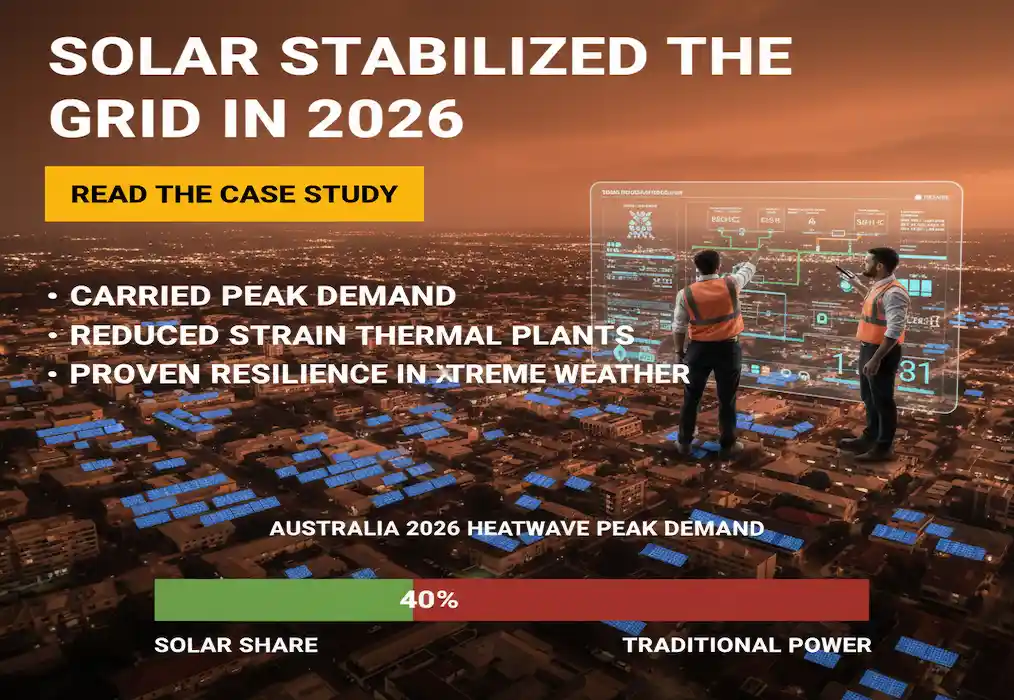
During those hottest days, solar generation across the market hit levels most people wouldn’t have believed just five years earlier. Rooftop solar systems—now perched on more than four million homes and businesses—churned out huge amounts of electricity right when people needed it most.
Big solar farms joined in, especially in sunny regions with clear skies. Together, rooftop and large-scale solar provided most of the electricity in the middle of the day, easing the pressure on coal and gas plants when it mattered most.
This perfect timing is the real story. Solar generation peaks at the same time as heat-driven demand. The more dangerous the heatwave, the better the conditions for solar—at least when skies stay clear.
Sure, extreme heat can make solar panels slightly less efficient, but the blazing summer sun in Australia more than makes up for it. The panels still crank out plenty of power on those cloudless, scorching days.
The upshot during January’s heatwave? Less stress on the rest of the grid. Coal and gas plants didn’t have to push right up against their limits at midday, so the risk of breakdowns dropped. Power lines weren’t as overloaded. Wholesale electricity prices stayed in check, thanks to all that cheap solar flooding the system.
A Structural Shift, Not a One Off Event
It would be a mistake to view the performance of solar during the January 2026 heatwave as an anomaly. Rather, it reflects a structural transformation in Australia’s electricity mix that has been underway for years.
Australia now has one of the highest rates of rooftop solar genetration in the world. In some states, particularly South Australia, rooftop solar has become a dominant feature of daytime electricity supply. Large-scale solar capacity has also expanded rapidly, supported by declining costs, favourable resource conditions and long-term power purchase agreements.
This growing solar fleet has altered the shape of electricity demand and pricing. Midday demand from the grid has flattened or declined in many regions, while evening demand ramps have become steeper as solar output falls away after sunset. These dynamics are now well understood by system planners and market participants.
What the January heatwave demonstrated is that this transformation has implications not just for decarbonisation, but for system resilience under extreme weather. Solar did not merely contribute to meeting demand; it changed the risk profile of the entire system during the most stressful hours of the day.
The Limits of Solar in Extreme Heat
Let’s be real solar power isn’t a magic fix for everything that goes wrong during extreme heat. That January 2026 heatwave put a spotlight on what happens when we lean hard on solar during the day.
Here’s the thing: when evening rolls in, the heat doesn’t just disappear. People crank up the AC, but the sun’s already dipped below the horizon and solar output drops fast. That’s a tough gap for the grid to fill. Batteries, hydro, and gas peakers all help bridge that, but none of them are perfect. They each bring their own mix of cost, technical headaches, and environmental baggage.
And there’s more—extreme heat messes with other parts of the renewable system too. Batteries don’t love high temperatures; their performance takes a hit. Inverters need careful attention so they don’t trip offline when the grid gets unstable. Then, when there’s way too much solar for the local demand and not enough ways to export it, you end up curtailing the excess.
None of this means solar isn’t valuable in a heatwave. Far from it. But it’s a reminder: solar alone won’t cut it. We need more storage, better transmission, and smarter grid services. The heatwave was a real stress test—solar held up, but it also gave us a preview of the next set of problems we’ve got to solve.
Reframing the Investment Case for Solar
If you’re looking at this from an investor’s perspective, January 2026 isn’t just about the short-term market chaos. It’s a sign of where things are heading in the long run.
People used to talk about solar in Australia mostly as a way to cut carbon—good for the planet, and backed by policy and public support. That’s still true, but this summer’s events add another layer: solar is now a key player in keeping the lights on as the climate gets hotter.
Longer, nastier heatwaves mean daytime electricity demand will just keep climbing. Solar lines up perfectly with those peak hours, so it’s set to grab an even bigger chunk of the energy market when prices are highest. That’s a big deal for how we plan infrastructure, design markets, and decide where to put our money.
But here’s the catch—not every solar investment is the same. Just building panels isn’t a guaranteed win. Companies that help the grid stay flexible, tackle heat-related issues, or combine solar with storage will probably come out on top. The same goes for energy companies that do it all—generation, storage, and retail. As the grid gets trickier, being able to handle complexity will matter more than ever.
At the same time, investors must remain mindful of risks. Policy settings can change, supply chains remain exposed to global disruptions, and valuation cycles in renewable energy have historically been volatile. The lesson of January 2026 is not that solar guarantees returns, but that its role in the energy system is becoming more central and more defensible.
Climate Reality and Energy Planning
The January heatwave also underscores a broader reality confronting policymakers and planners. Climate change is no longer a distant risk to be modelled; it is an operational challenge shaping daily decisions about energy supply, infrastructure resilience and public safety.
Australia’s geography and climate make it particularly exposed to extreme heat, but they also provide an abundance of solar resources. The challenge is to translate that resource advantage into a system that can reliably meet demand across all conditions, not just during the sunniest hours.
Solar’s performance during this heatwave suggests that progress is being made. The grid did not buckle under pressure in the way it once did, and a technology often criticised for its intermittency proved to be a stabilising force during the most demanding part of the day.
That does not mean the transition is complete. Further investment in storage, transmission and system coordination will be essential. But it does suggest that the direction of travel is clear.
Conclusion
Australia’s January 2026 heatwave was one of the most significant extreme weather events in recent years, both in terms of temperature and its impact on communities and infrastructure. It was also a revealing moment for the nation’s energy system.
Where previous heatwaves exposed the fragility of a system reliant on ageing thermal generation, this event highlighted the growing role of solar power in maintaining stability during peak demand. Solar did not eliminate all challenges, but it materially reduced the stress on the grid at the moment it mattered most.
For investors, policymakers and energy planners alike, the lesson is not that solar is a silver bullet, but that it has moved from the margins to the centre of Australia’s energy resilience. In a hotter, more volatile climate, that shift carries implications that extend well beyond emissions targets.
The January heatwave was a warning, but it was also a demonstration. Solar power, once dismissed as supplementary, is now carrying a meaningful share of the load when conditions are at their most extreme. How Australia builds on that foundation will shape the next phase of its energy transition.


 FAQs
FAQs