
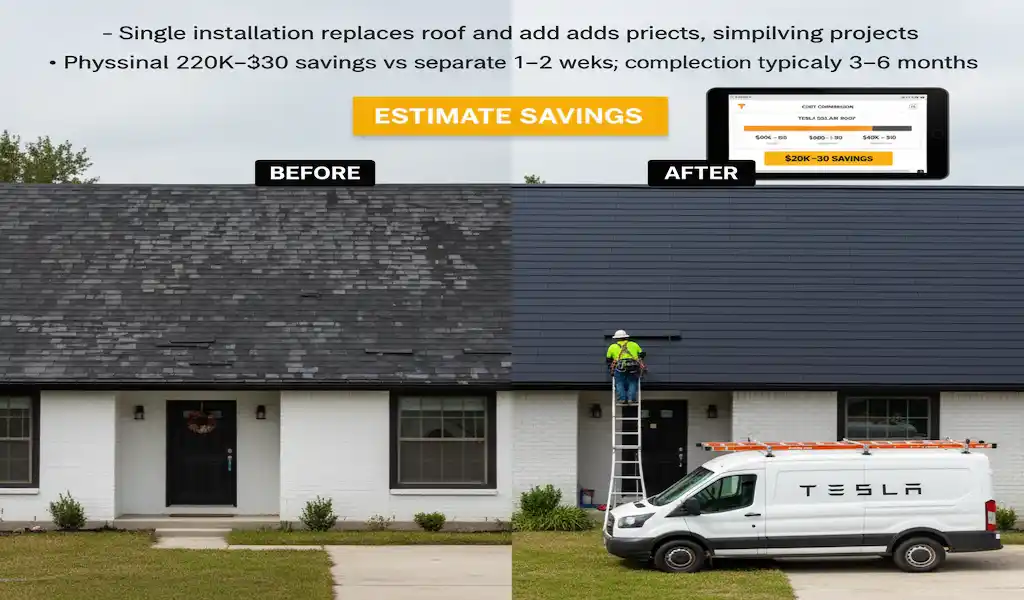
The average Tesla Solar Roof costs between $60,000 and $150,000 in 2026, although some homes pay less and luxury homes pay more. Most homeowners replacing a 2,000-square-foot roof spend around $100,000 before incentives and about $70,000 after the federal tax credit.
If you’ve ever looked at your roof and thought, “I wish I could harness the sun without ruining the look of my home,” Tesla Solar Roof might just feel like it was made for you. Introduced in 2017, the Tesla Solar Roof is more than just a solar panel system — it’s a full roof replacement made of photovoltaic glass tiles that seamlessly generate electricity while mimicking the appearance of premium roofing materials. The concept is straightforward: your roof should protect your home and produce clean energy at the same time, without those bulky black panels staring back at the street.
In this Top Solar Picks guide, I’ll walk you through everything you need to know about Tesla Roof price in 2026. You’ll get the details: price per square foot, installation fees, your expected return on investment, and how long it usually takes to break even. I’ll also show you how it stacks up against regular solar panels so you can figure out if the upgrade is really worth it for your home.
This guide on Tesla Roof Price was last updated by Top Solar Picks on July 22, 2026, to ensure accurate and up-to-date information for homeowners, and off-grid users.
Table of Contents
- Tesla Solar Roof Cost in 2026 (Quick Answer)
- What the Tesla Solar Roof Is and How It Works
- Cost Breakdown, Price Per Square Foot & Real Pricing
- Tesla Solar Roof vs Traditional Solar Panels
- Specs, Efficiency & Performance (2026 Update)
- Installation Cost Factors and What Affects Pricing
- ROI, Payback Period & Monthly Savings
- Installation Process and Timeline
- Pros and Cons of Tesla Solar Roof
- Cost Comparison vs Other Solar Systems
- UK Availability and Global Pricing
- Frequently Asked Questions
- Final Verdict: Is It Worth It in 2026?
Quick Cost Summary
Tesla Solar Roof vs. Traditional Solar Panels
When comparing a 12 kW system on a 2,000 sq ft home:
| Factor | Tesla Solar Roof | Traditional Panels + Roof Replacement |
|---|---|---|
| Cost | $100K–$111K | $40K–$50K |
| Per Watt | $7–$16 | $2.50–$3.50 |
| Efficiency | 11–14.5% | 15–22% |
| Output | 15K–18K kWh | 18K–21K kWh |
| Payback | 15–25 yrs | 7–12 yrs |
| Install Time | 3–9 months | 1–3 months |
| Best For | Aesthetics, new roofs | ROI, flexibility |

Why You Can Trust Top Solar Picks
At Top Solar Picks, we put together our solar guides by digging into manufacturer specs, digging through independent research, looking at real installation stories, and listening to what homeowners actually say. For this Tesla Solar Roof guide, we checked current prices, installation details, federal incentives, performance numbers, and long-term ownership costs from a bunch of reliable sources to give you a fair, up-to-date summary.Instead of echoing marketing blurbs, we zero in on what matters: how much a Tesla Solar Roof really costs, what drives up or down that price, how it stacks up against regular solar panels, and whether it’s actually worth the money in the long run. We also keep our guides updated, so if pricing, tax breaks, or the product itself changes, you'll see that reflected in what you read here.
Learn more →What Is Tesla Solar Roof & How It Works
Installing the Tesla Solar Roof actually means tearing off your whole roof. The roof surface is composed of two different types of tiles: the active solar tiles and the inactive non-solar tiles. Some 71% of the roof surface consists of these active tiles that contain high-efficiency monocrystalline photovoltaic cells. 29% of the roof surface is covered with purely aesthetic tiles that fill shaded areas and edges to give off an impression of a seamless appearance.
Tesla has four primary styles-textured glass, smooth, slate, and Tuscan-which are then designed to fit onto more generally accepted premium roof materials. If you have a traditionally suburban house or a very modern minimalist design, the Solar Roof will integrate just fine, hiding its new generation charms when compared to conventional panels.
Process of Generating Electricity:
- Sunlight Capture – Each tempered glass solar tile converts sunlight into DC electricity at approximately 72 watts per tile. Tesla tiles are designed to obtain energy in an effective manner even during diffuse light conditions.
- Inversion – Tesla Solar Inverter converts the generated direct current to alternate current for household usage with 97.5% efficiency.
- Home Prioritization – The electricity is first used in your house; any excess will go to Tesla Powerwall storage units and any surplus could be exported to the grid, depending on whether your utility allows net metering.
- Storage & Backup – Optional Powerwall 3 batteries would allow energy storage for use at night or during an outage. Each unit can store 13.5 kWh and costs approximately $11,500.
- Grid Intertie – Whenever your setup generates excessive energy that can neither be stored nor consumed, the excess is compensated back to your utility, further stretching savings on.
Important Note: Tesla Solar Roof is ideal for new builds or homes that need a full reroof. Retrofitting over an existing healthy roof can add $6,000–$20,000 in demo costs, making the total project significantly higher.
UK Homeowners: While Tesla hasn’t officially launched in the UK, estimated costs range between £22,000–£55,000, and solar exports via SEG are possible, though without the ITC equivalent.
How Solar Tiles Work
A solar roof actually uses two kinds of tiles: active solar tiles, which have photovoltaic cells, and inactive tiles that help with the structure and keep the look consistent. The active tiles soak up sunlight and turn it into direct current (DC) electricity. Even if it’s cloudy or you’ve got a bit of shade, they’ll keep working efficiently, so they’re a good pick in all sorts of climates.
Energy Generation Process
After the tiles catch the sunlight, here’s what happens next: The tiles generate DC electricity. Then, a solar inverter flips that DC into usable alternating current (AC) electricity. Your home pulls from that power first, and if there’s any left, it heads into storage or out to the grid.
The neat part is that your daily household needs come first, so you’re less tied to your local utility company. That’s how you start saving money on your electric bill month after month.
Tesla Powerwall Integration
You can connect the system to a Tesla Powerwall, which stores any extra energy your panels make. That energy can come in handy at night, when there’s a blackout, or when utility rates go up during peak hours. Having that battery means you’re more independent and can manage when and how you use your own electricity.
Tesla Solar Roof Specs & Performance
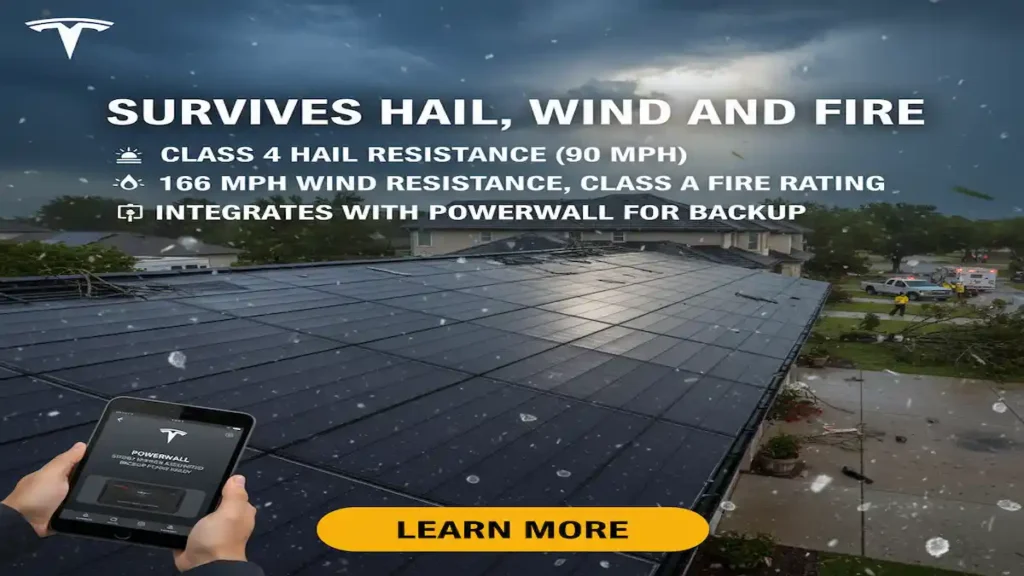
Tesla’s V4 tiles, blended with remaining V3.5 stock, focus on durability while maintaining respectable efficiency. No official system efficiency is published, but real-world reports indicate 11–14.5% overall efficiency, slightly lower than conventional rooftop panels, largely because of inactive tiles and flat roof installation.
| Spec Category | Detail | Notes |
|---|---|---|
| Power Output | 72W per active tile (15" × 45") | Typical system: 10–20 kW |
| Efficiency | Tile: 19.8%; System: 11–14.5% | Panels: 15–22% |
| Durability | Hail: Class 4 (2" @ 90 mph); Wind: 166 mph; Fire: Class A | 3× stronger than standard tiles |
| Warranty | 25 yrs power (80% output); 25 yrs product/weatherization | Beats asphalt roof 20 yrs |
| Weight | 13.5 lbs/sq ft | Comparable to concrete tile |
| Inverter | Tesla Solar Inverter, 97.5% CEC efficiency | Integrated, app-controlled |
V4 tiles increase low-light performance by 5–10%.
Hail protection now standard for storm-prone areas.
Production remains limited at roughly 23 installs per week globally (its peak rate in Q2 2022), meaning lead times can be long — according to Electrek (May 2026).
Tesla Solar Roof Cost in 2026
Pricing for a Tesla Solar Roof varies widely depending on roof size, complexity, Powerwall upgrades, and location. On average, U.S. homeowners can expect to spend $60K–$150K pre-incentives, or roughly $7–$16 per watt, which is 2–5× more expensive than traditional panels. For a detailed breakdown of Tesla Solar Roof costs, see our full Tesla Solar Roof Cost 2025 guide.
The cost of a Tesla Solar Roof in 2026 really comes down to your roof’s size, how complicated the design is, and whether you want extras like the Tesla Powerwall for battery storage.
Here’s what most homeowners can expect:
- Total system cost: $60,000 to over $150,000
- Price per square foot: $35 to $55+ (installed)
- Cost per watt: $7 to $16
If you’re already thinking about replacing your old roof, you can actually save $6,000 to $20,000 by bundling the replacement with the Solar Roof.
Real-World Example: Medium-Sized Home
Roof size: 2,000 sq ft
System size: 10–15 kW
Pre-incentive cost: $100K–$111K
After 30% ITC: $70K–$78K
Monthly savings: $120–$180
Payback: 15–22 years
Add-Ons
Powerwall 3: 2–3 units, adding $23K–$34.5K
Demo/Upgrades: $6K–$20K
UK/Global: Estimated £22K–£55K, but no ITC.
Saver Hints: It is important that you obtain the 30% ITC before the expiration of December 31, 2025; use whatever local state rebates are available, averaging a total of $2500; and use net metering whenever feasible.
Tesla Solar Roof Advantages and Disadvantages (2026)
Pros
Aesthetic Value: The Tesla Solar Roof tiles are nearly invisible from street level compared to traditional solar panels. They integrate seamlessly into the roof using special glass tiles that closely resemble premium roofing materials (such as slate or tile), providing a much more discreet and aesthetically pleasing appearance.
Dual Duty: Roof + solar in one, saving $20K–$30K on a separate reroof.
Durability Beast: Class 4 hail, 166 mph wind, Class A fire.
Ecosystem Magic: Tesla app and Powerwall for outages and storm monitoring.
Longevity: 25-year warranties on both power output and roof durability.
Complex Roof Fit: Works around vents, skylights, and irregular geometries.
Cons
Sticker Shock: $100K+ average cost — 2.5–4× panels.
Efficiency Lag: 11–14.5% system-wide vs. panels at 15–22%.
Install Delays: 3–9 months for permitting and scheduling.
Service Gripes: Limited certified installers, especially in the UK.
ROI Hit: Long payback periods (15–25 years).
Non-Modular: You cannot add tiles later.
the Tesla Solar Roof is a good addition to the residential solar market, combining premium roofing materials with integrated solar technology. it stand out great for homeowners who value quality, durability and clean energy in a single project.
Installations Process and Timeline (2026)
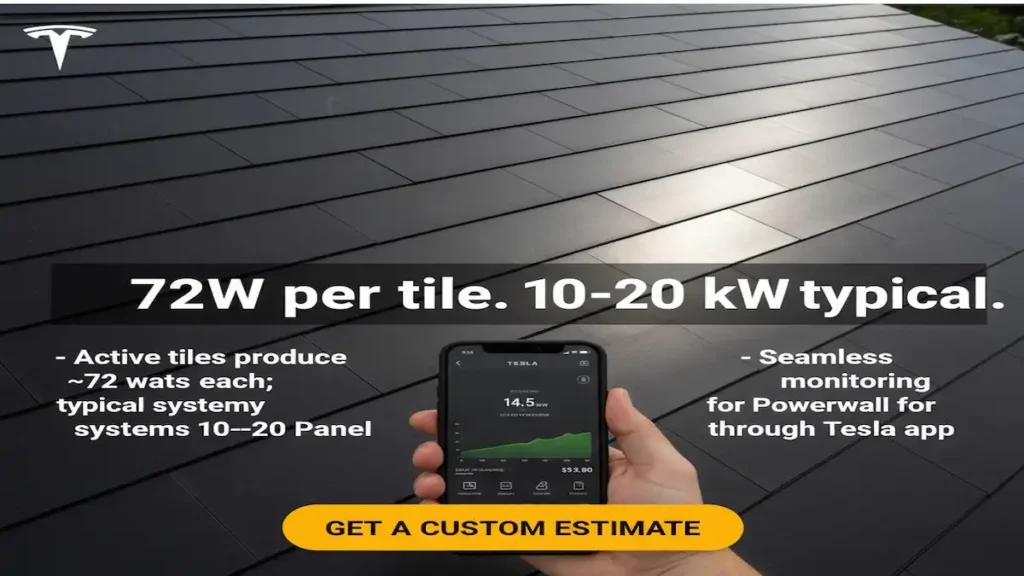
Installing the all-new Tesla Solar Roof is a lengthy project because it involves the installation of a modern-day solar roof while replacing the whole existing roofing structure to take the Powerwall backup batteries as an option. This is a project Tesla will have completed itself, but a few stages might be assigned to certified third-party crews. The project completion timeline looks like this on a well-structured normal time:
Design/Quote (1–3 days): Tesla’s online tool creates a layout using your address and electricity bill.
Assessment (1–2 weeks): Virtual or in-person roof scan.
Permitting (3–8 weeks): Tesla manages, but delays are common.
Installation (1–2 weeks): Full tear-off, tile installation, electrical setup.
PTO/Activation (2–6 weeks): Inspection and utility approval.
Total: 3–6 months in the U.S., longer if relying on third-party installers.
Related Posts
Payback Period & ROI
The average Solar Roof payback ranges 15–25 years, compared to 7–12 years for panels. Lifetime savings after payback can range $50K–$100K, depending on electricity rates, sun exposure, and system size.
Quick ROI formula:
Years to Payback=Net CostAnnual Savings\text{Years to Payback} = \frac{\text{Net Cost}}{\text{Annual Savings}}Years to Payback=Annual SavingsNet Cost
Example: $78K net cost ÷ $1,800/year savings ≈ 17 years.
UK homeowners see 14–20 years via SEG, but panels often remain the more cost-effective choice.
What Affects Installation Cost
Prices for a Tesla Solar Roof vary—a lot. Typical systems run anywhere from $60,000 to well over $150,000. What you actually pay depends on your home’s design, how much energy you use, and how tricky your roof is to work on. Two houses might look the same from the street but end up with very different final bills because of these details.
Roof Size
Bigger roof? Bigger bill. You’ll need more tiles, more materials, and more time for installation. That all adds up fast. So, the larger your roof, the higher the cost.
Roof Complexity
The layout of your roof can really change the price, too. If your roof has a lot of angles, steep spots, or things like chimneys or skylights, installers need to customize a lot more. That takes extra time and labor, which drives the cost higher. Simpler roofs are always easier—and cheaper—to get done.
Battery Storage
If you add a Tesla Powerwall, your initial cost will go up, but you gain extra energy independence. With a battery, you can store extra solar power, use it during outages, or rely less on the grid. Even though it costs more upfront, the savings and peace of mind can pay off in the long run.
Labor and Permits
Where you live matters, too. Local labor rates, permit fees, and inspection requirements all play a role in what you’ll end up paying. In some places, it takes longer to get permits, which can stretch out your project and increase total costs.
Average Payback (15–25 years)
Most people see a payback time somewhere between 15 and 25 years. It depends on your local electricity rates, how much sun you get, your system size, and if you included battery storage. If you’re in an area with expensive electricity, you’ll see payback sooner.
Monthly Savings Example
Homeowners usually save from $120 to $180 a month on average. And as electricity prices go up, your monthly savings can, too—so the system’s value actually increases with time.
ROI Formula
There’s a simple equation for estimating payback time: Payback Period = Net System Cost ÷ Annual Electricity Savings.
Here’s a sample breakdown:
- Net system cost: $78,000
- Annual savings: $1,800
- Payback period: about 17 years
That gives you a clear idea of when your solar roof will start paying for itself.
Tesla Solar Roof vs Solar Panels
Compared to standard panels, the Tesla Solar Roof is:
- 2–4× more expensive upfront
- Slightly lower system efficiency (due to inactive tiles)
- But includes a full roof replacement + solar system in one
What We Learned After Comparing Dozens of Tesla Solar Roof Installations
the complexity of your roof usually matters more than the size when it comes to the final price. Most folks figure a bigger roof automatically means a bigger bill, but that’s not always true. For example, a simple 2,500-square-foot roof with clean lines and hardly any obstacles can actually be cheaper to cover than a smaller, 1,800-square-foot roof packed with dormers, chimneys, steep angles, and skylights. All those extra features need more labor, special tile cuts, and way more time, which drives the cost up a lot.
So, if you’re getting quotes, don’t just fixate on the square footage. Make sure every installer explains how your roof’s shape, slope, and details play into their estimate. Once you understand that, the differences between quotes—sometimes by thousands of dollars—start to make a lot more sense, even when the homes are similar in size.
Frequently Asked Questions (2026)
How much will a Tesla Solar Roof cost me in 2026?
In 2026, most Tesla Solar Roofs land somewhere between $60,000 and $150,000+ before any rebates or tax credits. The exact amount depends on your roof’s size and complexity, the size of your solar system, and whether you go for battery storage. Installation usually falls in the $35–$55 per square foot range.
What is the price per square foot for Tesla Solar Roof?
Most homeowners pay $35 to $55 for each square foot, since the Solar Roof covers both roofing and solar generation. Complexity and energy needs push the price up or down.
Is Tesla Solar Roof worth it compared to regular panels?
Honestly, if you just want the best bang for your buck, traditional solar panels usually win. But if you’re planning a new roof anyway and care a lot about looks, long-term durability, and having everything integrated, Tesla’s Solar Roof has a real appeal. Panels give you a faster payback. The Solar Roof is more about design and value over time.
How long until the Solar Roof pays for itself?
Most homeowners break even in 15 to 25 years, depending on things like local electricity rates, how much sun you get, and what size system you install. If your home uses a ton of power or gets great sunlight, you could break even faster, especially with a Powerwall.
Will the Solar Roof work if it’s cloudy a lot?
Yep, still works. You’ll see about 20–30% less output when it’s cloudy compared to full sun, but you can still cut your electric bills pretty well—especially if you add battery storage.
Can I add more Solar Roof tiles later?
Nope. It’s a full-roof system, not a modular one. You need to replace the whole roof at once—expanding it later isn’t supported.
Is the Solar Roof heavier than a regular roof?
Not really. At about 13.5 pounds per square foot, it’s similar in weight to materials like concrete tiles. It’s designed to be a direct, safe swap for your old roof.
Is the Tesla Solar Roof available in the UK?
Availability is pretty limited in the UK. Most customers will end up on a waitlist or need a special installation. Typical total costs range from £22,000 to £55,000, based on the roof’s size and system setup.
Final Verdict: Tesla Solar Roof in 2026 — Luxury or Luxury Trap?
The Tesla Solar Roof is stunning, storm-proof, and technologically advanced. For those reroofing anyway and valuing aesthetics, it’s unmatched. However, at $100K+ average cost, it’s not a budget-friendly, ROI-focused solution. Panels deliver 2× faster payback and more energy per dollar spent.
If you plan to stay in your home long-term, need a roof replacement, and care about style, durability, and integrated battery backup, the Tesla Solar Roof is a solid luxury investment. Otherwise, high-quality panels are the smarter financial move.
Next Steps: Get three quotes, compare system sizes, check ITC eligibility, and use Tesla’s online cost calculator to see what works for your home.
Author

Top Solar Picks is a team of solar enthusiasts and renewable energy researchers with hands-on experience testing solar generators, panels, and battery storage systems.