
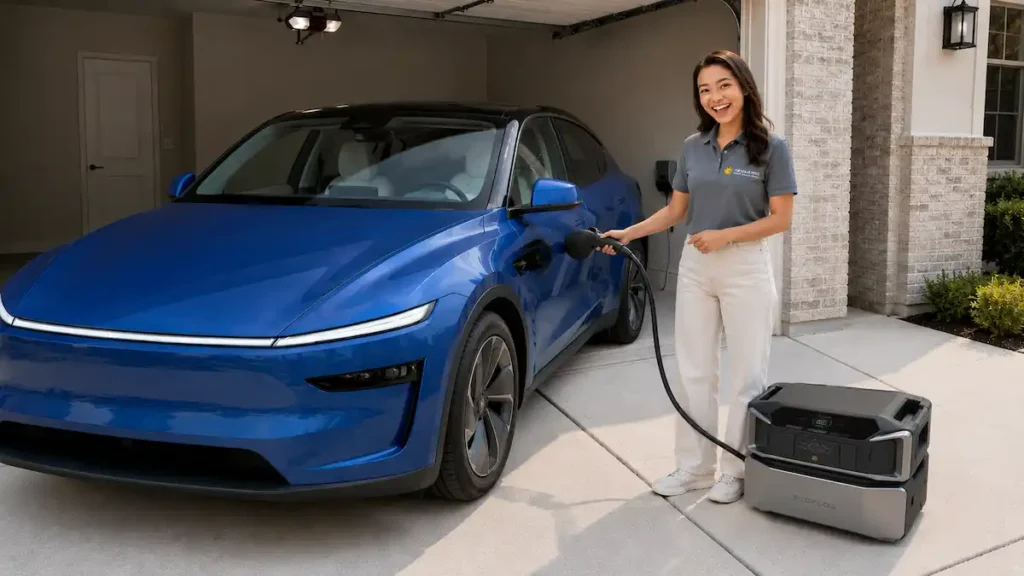
Electric driving isn’t about charging from the grid — it’s about powering your own clean energy system. With home solar systems on the rise, increasingly more car owners are pairing their EVs with solar panels to save on charging, become energy independent, and maintain their carbon footprint low.
All electric vehicles are not solar-created equal, though. Some are ready for solar integration, highly efficient to charge, and ready for off-grid or solar installations. Others, such as the Aptera or Lightyear 2, advance the future with solar panels integrated into the vehicle that can actually charge the vehicle itself.
The amount of solar power needed for EV charging depends mostly on how far you drive and whether you plan to charge only your car or support your entire home as well. In general, heavier daily driving requires larger solar systems and battery storage for consistent charging.
Estimated Solar System Size for EV Charging
| Driving Style | Recommended Solar System | Battery Storage |
|---|---|---|
| Light daily driving | 5–6 kW | Optional |
| Daily commuting | 6–8 kW | Recommended |
| Heavy driving | 10 kW+ | Strongly recommended |
| Multiple EVs | 12–15 kW+ | Large battery bank |
These numbers are general estimates, not exact requirements. Actual system size can vary based on sunlight conditions, EV battery size, charging habits, and how much electricity your home already uses each day.
Here are the top EVs of 2026 that provide you with the most out of your residential solar installation — and the technology, equipment, and tools to get you there.
EVs That Pair Seamlessly with Solar Charging
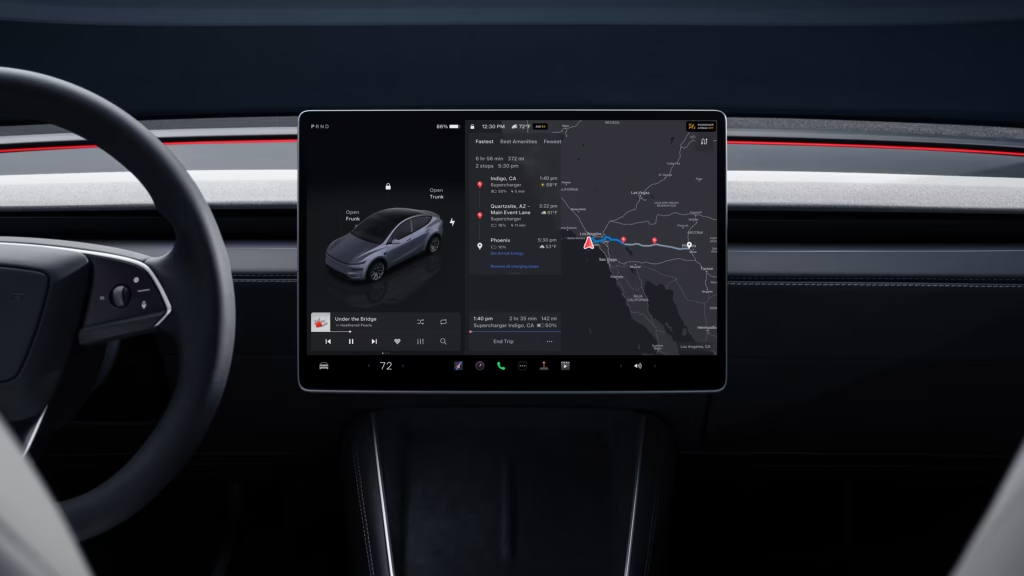
Not every electric vehicle behaves the same when it comes to solar charging. Some are highly efficient and easier to support with a home solar system, while others require more energy and larger setups to perform well in daily use.
| EV Model | Best For | Solar Compatibility |
|---|---|---|
| Tesla Model 3 & Model Y | Daily home charging | Excellent |
| Aptera Solar EV | Off-grid solar driving | Unique |
| Lightyear 2 | Solar-assisted efficiency | Emerging |
| Ford F-150 Lightning | Home backup + EV | Very Good |
| Hyundai Ioniq 6 | High efficiency commuting | Excellent |
In most cases, the most practical EVs for solar charging are the ones that combine efficiency with predictable energy use. Smaller, more efficient vehicles are generally easier to power fully from a home solar setup without needing oversized systems.
1. Tesla Model 3 & Model Y (2025 Refresh)
Still at the forefront, Tesla’s revised 2025 model lineup is fully compatible with home solar arrays. With energy monitoring via the Tesla app and rapid Level 2 charging, they are designed to function with solar systems like the Zendure Solar Generator or Eco-Worthy Inverter Kits.
2. Aptera Solar EV
Aptera stands in a league of its own — a solar car that provides up to 40 miles of daily range from built-in solar panels. An excellent choice for sunny weather, this ultra-lightweight car is perfect for drivers who want to be completely off-grid.
3. Lightyear 2
Combining aerodynamic efficiency with solar power, the Lightyear 2 will drive up to 800 km (500 miles) on a charge using solar panels. It will arrive in the U.S. market later in 2025.
4. Ford F-150 Lightning
Designed for workday and weekend, the Lightning is energy system-integrated with the home with ease. It supports bidirectional charging, so you can store solar power and feed it back to your home during power outages.
5. Hyundai Ioniq 6
This highly efficient, aerodynamic EV is fast-charging and Bluetti solar generator-capable for backup and portable solar use. Its efficiency also makes it an excellent option for residential solar customers who want the best mileage per kilowatt-hour.
Can You Charge an EV With Solar at Home?
Absolutely, you can use home solar power to charge an electric vehicle. More people are getting into it for 2026 and beyond. but here’s the thing: it all comes down to your setup. If you’ve only got a few panels, you might not get enough juice for daily EV charging. With a bigger solar system and battery storage, though, you can power your car most days and rely a lot less on the grid.
Usually, your solar panels will create electricity during the day. That power can go straight into your EV if you’re home and plugged in, or it can be stored in batteries for nighttime charging.
With a large, well-designed system, you could easily cover most of your regular driving with solar energy—especially if you plug in during daylight hours.
How Much Solar Do You Need for an EV?
It really depends on your driving habits and how efficient your EV is. Most EVs need around 25–35 kWh for a full battery charge. To do that with solar, you’ll want a system that makes enough power not just for your car, but for your home, too.
Here’s a rough guide:
- If you drive short trips daily: a 5–6 kW system usually does the trick.
- For regular commuting every day: look at 6–8 kW.
- If you drive a lot or have more than one EV: go with 10 kW or bigger, and definitely consider battery storage.
Keep in mind—it isn’t just about the panels. You’ll need battery storage if you want to charge at night; without that, you’re stuck charging in the daytime when the sun’s out.
Best Solar Setup for EV Charging
When it comes to charging your EV reliably at home, your solar setup makes the difference.
A standard solar EV charging system usually looks like this:
- Solar panels
- Hybrid inverter
- Battery storage
- Level 2 EV charger (recommended for faster charging)
Want to go bigger or more flexible? Some homeowners add things like:
- EcoFlow portable and backup systems
- Bluetti solar generators
- Eco-Worthy inverter and battery kits for whole-home setups
These options store the extra power you make during the day so you can charge at night or in bad weather. Hybrid inverters work best for most people—they handle home energy needs and car charging at the same time, without overloading your system.
Solar EV Charging Cost Breakdown
Most folks switch to solar EV charging to save money. Once your system’s installed, charging your car is nearly free (besides upfront costs).
Here’s the gist:
- Charging from the grid: can be expensive, depending on rates
- Charging with solar: super cheap once you’ve set up the system
- Over time: big savings, especially if electricity rates keep climbing
The biggest savings come from adding batteries to your setup. Then you can use low-cost daytime power anytime you want, not just when the sun’s shining. All in all, most people see solar EV charging as a way to lock in stable energy costs and avoid getting burned by unpredictable electricity prices.
Solar Features to Look For
When choosing an EV for home solar charging, keep the below factors in mind:
- Pre-wiring for solar: Some EV-ready homes come pre-wired for solar-compatible Level 2 charging.
- Solar array compatibility: Ensure that your EVSE (Electric Vehicle Supply Equipment) is compatible with your inverter, for example, the Eco-Worthy 48V inverter and batteries. Portable solar
- solutions: Devices like the Zendure SuperBase V or Bluetti AC200P offer adaptable charging when off-grid or in emergencies.
- Battery storage: Investigate the installation of battery systems to store excess solar energy for nighttime EV charging.
The Technology Behind Solar + EV Charging
New solar technology like solar-electric vehicles, V2H charging, and smart energy dashboards are offering homeowners more control over their energy consumption than ever before. With the integration of solar generators, inverters, and intelligent EV chargers, you can run completely on sunshine — usually for less than 4 cents per mile.
Home Solar vs Off-Grid EV Charging: What’s the Difference?
If you’re considering solar power for your EV, it’s important to know the difference between home solar charging and off-grid EV charging — and what each means for your lifestyle, savings, and independence.
Charging at Home with Grid-Tied Solar
Most homeowners install grid-tied solar systems with the goal of offsetting their energy bills. These systems:
Connect to your local power grid
Supply solar power during the day
Pull from the grid at night or on cloudy days
✅ Benefits:
Eligible for net metering (in many states)
Lower upfront cost than going off-grid
Perfect for daily home + EV use
❌ Limitations:
Doesn’t work during outages (unless paired with battery storage)
Still dependent on the grid
Example:
Emma from Arizona uses a Tesla Wall Connector at home. Her rooftop solar panels power both her home and Model Y during the day, and she gets credits from the utility when she generates more than she uses.
Charging Your EV Completely Off-Grid
Going off-grid means you’re not connected to the utility at all. Your EV charging comes entirely from solar + batteries + possibly a backup generator. This setup is ideal for:
Remote living
Emergency preparedness
Reducing reliance on power companies
✅ Benefits:
100% energy independence
Works even if the grid fails
Great for RVs, cabins, tiny homes
❌ Limitations:
Requires much larger battery banks (to handle EV charging load)
Higher initial cost for inverters, battery storage, and solar panels
Slower charging unless paired with a powerful system
Example:
James lives off-grid in Colorado. He uses a Bluetti AC200 Max solar generator, paired with Eco-Worthy batteries, to charge his Nissan Leaf overnight — all from solar harvested during the day.
Hybrid Option: Best of Both Worlds
Many people use a hybrid setup — grid-tied solar with a backup battery (like Zendure SuperBase V or Bluetti EP500). This gives:
Daytime solar charging
Grid fallback when needed
Power even during blackouts
It’s the most practical choice for suburban homeowners who want savings, convenience, and resilience.

Why You Can Trust Top Solar Picks
We don’t just list products based on specs or marketing claims. Most of what we publish comes from comparing how these systems actually behave in real use — things like how they handle daily charging, solar input in different weather conditions, and long-term reliability.
We also look at what real users are saying over time, especially when it comes to issues you only notice after weeks or months of use, not just on day one.
When possible, we cross-check products from brands like EcoFlow, Bluetti, Jackery, and Eco-Worthy so the information reflects real-world performance, not just product pages.
FREQUENTLY ASKED QUESTIONS: Solar-Powered EV Charging
1. Can I charge my EV completely using home solar panels?
Yes, you can — but it really depends on the size of your system and how you charge.
If your solar setup is properly sized and you charge during the day, most EV owners can cover a good portion or even all of their daily charging from solar. The challenge usually isn’t the EV itself, but having enough solar production and, in many cases, battery storage to carry energy into the evening.
For heavier driving or smaller solar systems, you’ll likely still rely on the grid at times.
2. How many solar panels do I need to charge an electric car?
There’s no exact number that fits everyone, but most EVs need a decent amount of energy each day.
A full charge can take roughly 25–35 kWh depending on the car. In real terms, that often means a medium to large home solar setup rather than a small starter system.
Your driving habits matter just as much as panel count. Someone driving short distances daily will need far less than someone commuting long range every day.
3. What’s the benefit of using a portable solar generator for EV charging?
Portable solar generators like Zendure or Bluetti are not really meant to replace a full home system, but they do help in certain situations.
They’re useful for backup power during outages, or when you need to top up an EV in an emergency or while traveling. Think of them more as a support system rather than your main charging source.
4. Are solar EVs like Aptera or Lightyear actually available yet?
Aptera is already taking reservations, and it’s one of the first solar-focused EVs getting real attention in the U.S.
Lightyear 2 is expected to roll out gradually, but availability will depend on production timelines and approvals.
They’re still early in the market, but they show where EV technology is heading.
Top Solar Picks Recommended Equipment for Solar EV Owners
Zendure SuperBase V Solar Generator – Strong, smart-app supported, and modular
Eco-Worthy Inverter + Battery Kits – Full solar systems for reliable, daily EV charging
Bluetti AC200P Solar Generator – Versatile power for home use and on the go
Affiliate Note: These tools are suggested by us based on their performance, dependability, and EV-compatibility. When you buy through our links, you’re supporting this website at no additional cost.
Final Thoughts
Pairing your EV with solar in your home is not just the eco-friendly thing to do — it is about owning your energy future. Whether you’re cruising in a futuristic Aptera or a tough F-150 Lightning, solar-friendly EVs in 2026 give you freedom, autonomy, and huge savings. And with technological advancements like Zendure, Eco-Worthy, and Bluetti, it has never been simpler to make your own clean energy system.
Author

John Tanko is the founder of Top Solar Picks and a solar energy researcher whose work has been featured in leading technology and sustainability publications. Learn more on our About page.