
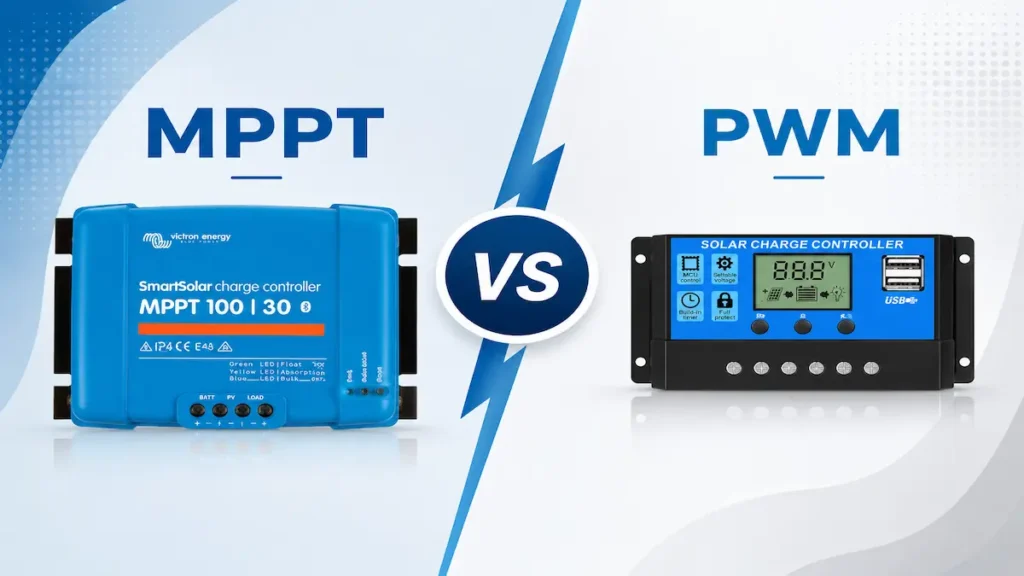
MPPT and PWM are the main types of solar charge controllers you’ll see, and they both regulate power from solar panels to batteries. But honestly, MPPT controllers tend to be way more efficient, especially for bigger or newer solar setups. The big draw with MPPT? It boosts charging efficiency by as much as 30% by converting extra panel voltage into usable current. On the flip side, PWM controllers basically do the trick for smaller, budget systems where the panel voltage lines up pretty closely with the battery voltage.
If you’re setting up an off-grid cabin, RV, lithium battery bank, or home backup solar in 2026, MPPT controllers usually win out for the long haul. They’ll charge better in cold weather, on cloudy days, and with high-wattage arrays. Still, PWM controllers stick around as a solid, affordable pick for no-frills systems with modest power needs. If you new to solar, first learn what a solar charge controller does and why every battery-based solar system needs one.
This guide explains the real differences between MPPT and PWM controllers: efficiency, battery compatibility, price, pros, cons, and which one’s best for your setup.
This guide on solar charge controller was last updated by John Tanko on May 15, 2026, ensuring accurate and up-to-date information.
What Is a Solar Charge Controller?
A solar charge controller is a vital component of any solar power system. It regulates the voltage and current coming from solar panels to the solar batteries, ensuring that batteries charge efficiently and don’t get overcharged or damaged.
Without a charge controller, your solar battery could be damaged from uncontrolled energy flow, drastically reducing its lifespan.

Why You Can Trust Top Solar Picks
We compare real-world solar performance, charging reliability, long-term user experiences, and practical testing — not just manufacturer claims. Products from brands like EcoFlow, Bluetti, Jackery, and Eco-Worthy are cross-checked using actual usage data and customer feedback.
Learn more →MPPT vs PWM: Meaning and Basic Differences
Understanding the differences between MPPT and PWM and their meanings is crucial before selecting the appropriate controller.
MPPT vs PWM Charge Controller Comparison
| Feature | PWM (Pulse Width Modulation) | MPPT (Maximum Power Point Tracking) |
|---|---|---|
| Technology | Directly connects solar panel to battery, reducing voltage to match battery level. | Uses advanced tracking algorithms to adjust voltage and current for maximum power output. |
| Efficiency | 70–80% | 95–99% |
| Price | Lower cost, budget-friendly | Higher cost but better long-term value |
| Ideal For | Small solar systems, basic RV setups, and low power needs | Large systems, off-grid homes, lithium batteries, and high-performance setups |
MPPT vs PWM Efficiency: Which Is Better?
When it comes to MPPT vs PWM efficiency, MPPT solar charge controllers clearly win the race.
- MPPT efficiency ranges from 95% to 99%, meaning you get more usable power from your solar panels.
- PWM controllers typically deliver 70% to 80% efficiency, which can result in significant energy losses over time.
Example:
If you have a 250W solar panel system, an MPPT controller can deliver up to 220W-240W to your battery, while PWM may only deliver 160W-180W.
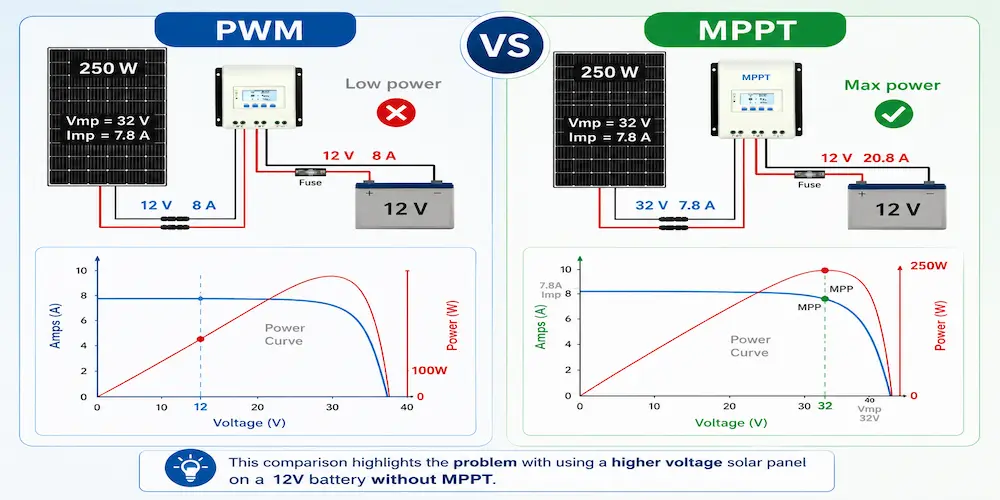
what this means: If you want to get the maximum output from your solar panels, especially in variable weather conditions, MPPT is the best choice.
Is MPPT Worth the Extra Cost?
For most current solar systems, MPPT controllers are absolutely worth the higher upfront price. They crank up charging efficiency and help your batteries perform better over time. Unlike PWM, MPPT keeps tracking the maximum power point and converts that extra voltage into usable charging current. You get up to 30% more power, especially when it’s cold, overcast, or you’re running a bigger solar array.
If you’ve got an RV, an off-grid place, lithium batteries, or backup solar at home, the extra efficiency pays for itself with quicker charging and improved energy production. But if your solar setup’s tiny—under 200W—a PWM controller will probably do the trick for less money.
Best Controller for RV Solar
For most RV solar in 2026, MPPT charge controllers are the go-to because they maximize efficiency in all sorts of changing weather as you travel. RV panels deal with shifting sunlight, partial shading, and temperature swings—all things MPPT handles way better than PWM.
MPPT also lets you run higher-voltage panels, which cuts wiring losses and speeds up battery charging. If your RV system is small and uses simple lead-acid batteries, PWM can work, but MPPT wins out for bigger banks, lithium batteries, or anyone living in their RV full-time.
Best Controller for Lithium Batteries
When it comes to lithium batteries, MPPT controllers are generally the best pick. Lithium needs tight control over charging stages and higher efficiency. Modern LiFePO4 batteries perform best with controllers that can precisely regulate voltage and current—MPPT does just that.
Lots of top MPPT controllers offer programmable profiles, Bluetooth monitoring, temperature compensation, and extra battery protection features designed for lithium. PWM controllers can work with lithium batteries too, but they usually have fewer settings and aren’t as efficient.
Can PWM Damage Lithium Batteries?
Set up right, a PWM controller normally won’t damage lithium batteries. Trouble pops up when the controller isn’t built for lithium charging profiles. Lithium batteries—especially LiFePO4—need exact voltages and protection from overcharging or deep discharge.
Older or cheap PWM controllers made for lead-acid batteries might not give lithium the right settings, which could cut battery life or trip the battery management system. That’s why most installers stick with MPPT for lithium: they’re safer and give more accurate control.
MPPT vs PWM in Cloudy Weather
MPPT controllers stand out in cloudy weather since they can constantly tweak voltage and current to grab the maximum power from your solar panels. Cloudy and low-light conditions make panel voltage bounce all over, which is exactly what MPPT is built to track.
PWM, though, just matches panel voltage to battery voltage—so you lose more energy if sunlight isn’t steady. If you live somewhere with plenty of clouds or winter, MPPT controllers charge faster and help your solar system perform way better than PWM.
VOC vs Battery Voltage Explained
The big split between MPPT and PWM comes down to how they deal with VOC (open-circuit voltage) versus battery voltage. VOC is the most your solar panel spits out when it’s not hooked to a load, while battery voltage is what your battery bank runs at.
PWM makes your solar panel work near the battery voltage, so any extra voltage gets wasted. Say your panel gives 20V and charges a 12V battery—you lose that difference with PWM. MPPT fixes that by turning the extra voltage into more charging current using DC-to-DC conversion, so you actually use more solar power.
That’s why MPPT controllers are so much better for modern solar setups with higher-voltage panels.
Panel Mismatch Losses in MPPT vs PWM Systems
Panel mismatch losses happen when you link together solar panels with different voltages, wattages, or sunlight exposure. These mismatches drag down system efficiency since the weakest panel limits the whole array.
MPPT controllers handle these losses better because they’re always tweaking output across changing voltages and currents. PWM is less adaptable and loses more energy when panels aren’t matched to the battery or to each other.
That matters most for RV solar, installs with partial shading, or expandable setups where panel conditions change all day.
Temperature Coefficient and Solar Charge Controller Performance
Solar panel voltage shifts a lot with temperature—which affects controller efficiency. In cold, panels make higher voltage; when it’s hot, voltage drops and so does output. That’s the temperature coefficient.
MPPT controllers shine in colder climates because they grab and convert that extra voltage into charging power. PWM can’t really use this higher voltage—they just knock it down to match the battery.
So, MPPT gets recommended for places with cold winters, big temperature swings, or where weather changes a lot.
DC-to-DC Conversion in MPPT Controllers
The main reason MPPT controllers are more efficient? They actually convert DC-to-DC voltage. Instead of wasting excess panel voltage, MPPT turns it into more charging current.
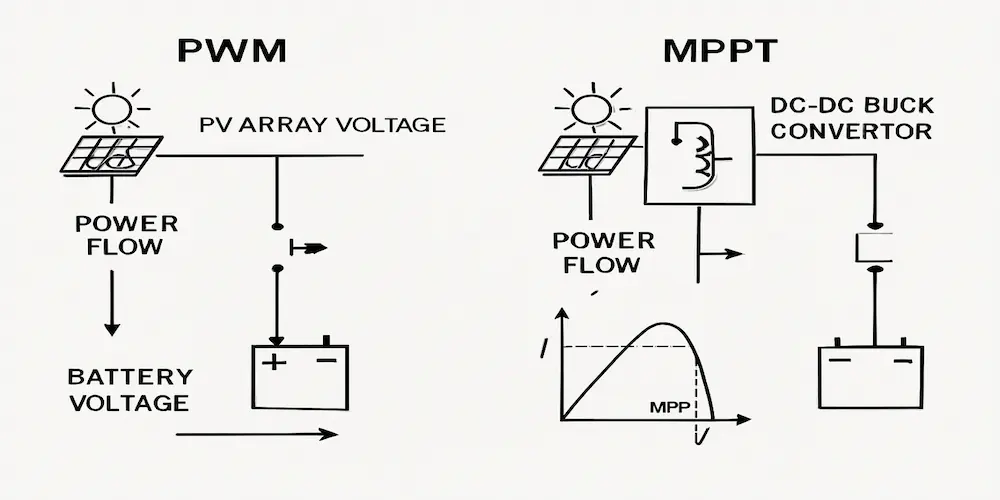
So if your panel runs at 24V and you’re charging a 12V battery, MPPT controller drops the voltage and bumps up the current. More solar power makes it to your battery.
PWM doesn’t convert voltage. It just wires the panel straight to the battery, so any voltage above battery level is lost.
Lithium Charging Profiles: MPPT vs PWM
Lithium batteries require more precise charging control than traditional lead-acid batteries, especially during bulk charging, absorption, and float stages. Many modern MPPT charge controllers include programmable lithium charging profiles specifically designed for LiFePO4 and other lithium battery chemistries.
These charging profiles help prevent overcharging, overheating, and battery management system (BMS) shutdowns while maximizing battery lifespan and charging speed. PWM controllers can support lithium batteries if properly configured, but lower-cost PWM models often lack advanced charging customization and monitoring features.
For most lithium solar battery systems in 2026, MPPT controllers are considered the safer and more efficient choice.
How MPPT Tracking Curves Improve Solar Efficiency
MPPT stands for Maximum Power Point Tracking, which refers to the controller’s ability to continuously monitor and adjust solar panel operating conditions to find the point where power production is highest. This operating point changes throughout the day depending on sunlight intensity, temperature, and shading conditions.
An MPPT tracking curve represents how the controller dynamically adjusts voltage and current to maintain peak solar output. By constantly tracking this maximum power point, MPPT controllers can extract significantly more usable energy compared to PWM controllers, especially in changing weather conditions.
This dynamic tracking capability is one of the main reasons MPPT systems are preferred for high-performance solar installations.
Series vs Parallel Solar Panels: MPPT vs PWM
The way solar panels are wired — in series or parallel — can strongly affect charge controller performance. MPPT charge controllers work exceptionally well with series-wired solar panels because they can handle higher input voltages efficiently while reducing power loss through long cable runs.
Series wiring increases voltage while keeping current lower, which improves overall system efficiency and reduces wiring costs. PWM controllers are generally less flexible because they require solar panel voltage to closely match battery voltage.
Parallel wiring is more commonly used with PWM systems because it keeps voltage lower and closer to battery operating voltage. However, for larger solar arrays and expandable systems, MPPT controllers paired with series wiring usually deliver better overall performance.
Shading Performance: MPPT vs PWM
Partial shading can dramatically reduce solar panel output, but MPPT charge controllers are better equipped to recover usable energy during shaded conditions. Because MPPT technology constantly adjusts voltage and current to find the highest available power point, it can continue operating more efficiently even when sunlight levels fluctuate.
PWM controllers are less adaptable during shading because they cannot optimize panel voltage independently from battery voltage. This often results in greater power losses when clouds, trees, dirt, or nearby objects partially block sunlight.
For solar systems installed in areas with inconsistent sunlight or temporary shading, MPPT controllers usually provide more stable and reliable charging performance throughout the day.
PWM vs MPPT Controller Advantages and Disadvantages
PWM Charge Controller — Pros & Cons
What PWM does well
People still use PWM controllers a lot because they are simple, inexpensive, and reliable. For basic solar setups—like small RV systems, garden lights, or standard 12V battery banks—they get the job done without making things complicated. The straightforward design means they’re less likely to break, and you don’t need to mess around with advanced settings.
Where PWM falls short
Honestly, the main problem is efficiency. PWM controllers just make your panel voltage match the battery voltage. They don’t really “work smart” to pull the most energy from your solar panels. So, any extra power your panels could create? It pretty much gets wasted. If you’re running bigger systems, using higher-voltage panels, or dealing with cloudy days, you’ll feel that loss even more. Over time, all that wasted energy adds up.
MPPT Charge Controller — Pros & Cons
Why MPPT is preferred in modern systems
Most professional solar setups use MPPT controllers because they actually make better use of your solar panels. Instead of throwing away excess voltage, they turn it into extra charging current for your batteries. In real-world conditions—early mornings, late afternoons, or cloudy weather—you’ll really notice the difference.
Plus, they work great with lithium batteries and larger solar arrays. If your system is off-grid or pulls more than a few hundred watts, MPPT will usually charge batteries faster and deliver better results over the long haul.
The trade-offs
The big downside is price. MPPT controllers cost more, and if you’re only running a tiny solar setup, the extra efficiency might not be worth it. Also, they’re more complex on the inside, but once you set them up, you don’t really have to worry about that.
Frequently Asked Questions
Is MPPT better than PWM for solar systems?
Yeah, MPPT charge controllers are usually better. They’re more efficient and draw more usable power from your solar panels. You’ll see the biggest advantage in bigger solar setups, cloudy weather, and with lithium batteries. PWM controllers make more sense if you’re going for something small and affordable.
How much more efficient is MPPT compared to PWM?
MPPT controllers tend to be about 15% to 30% more efficient, depending on your solar panel voltage, the weather, and your battery type. When it’s cold or cloudy, the difference really stands out.
Is MPPT worth the extra cost?
For most solar projects these days, it is. You pay a little more at the start, but MPPT controllers usually charge batteries faster and make better use of your panels. If you have an RV, an off-grid cabin, a lithium battery, or need backup power at home, paying extra for MPPT generally pays off.
Can PWM charge lithium batteries?
Some PWM controllers can charge lithium batteries, but only if they include lithium charging profiles. A lot of budget PWM units are designed for lead-acid batteries and don’t have the right charging options or control for lithium.
Which charge controller is best for RV solar?
MPPT controllers almost always win here. They pull more power in changing weather conditions and pair well with the higher-voltage panels used in modern RV systems. If you want the most out of your solar in an RV, go with MPPT.
Final Verdict: MPPT vs PWM Solar Charge Controller — Which One you Should Buy?
When comparing MPPT vs PWM solar charge controllers, the right choice ultimately depends on your solar system size, battery type, budget, and long-term energy goals. PWM charge controllers remain a simple and affordable option for small solar setups with basic power needs, especially for low-wattage RV, cabin, and lighting systems. However, they are less efficient because they cannot optimize solar panel voltage or recover unused power.
MPPT charge controllers, on the other hand, are designed for higher efficiency, faster battery charging, and better overall solar performance. Their ability to convert excess panel voltage into usable charging current makes them the preferred option for modern off-grid systems, lithium batteries, home backup power, RV solar installations, and larger solar arrays. MPPT controllers also perform better in cold weather, cloudy conditions, partial shading, and high-voltage solar configurations.
For most solar users in 2026, MPPT controllers are generally the better long-term investment because the increased efficiency and improved charging performance can offset the higher upfront cost over time. However, if you are building a small budget-friendly solar system with limited power requirements, a quality PWM controller may still provide reliable performance at a lower price point.
Before choosing a solar charge controller, consider your future expansion plans, battery chemistry, panel voltage, and daily energy usage. Selecting the right controller from the beginning can improve battery lifespan, maximize solar output, and make your entire solar power system more efficient for years to come.
Author

John Tanko is the founder of Top Solar Picks and a solar energy researcher whose work has been featured in leading technology and sustainability publications. Learn more on our About page.