
If you’re setting up a small solar system, you’ll probably wonder: does a 100W solar panel need a charge controller? Honestly, yes, in most cases. A charge controller regulates the power moving from your solar panel to your battery. It’s basically there to keep your batteries from getting overcharged and damaged.
Even though 100 watts sounds like a modest setup, that panel can still pump enough power to mess up a battery if you hook it up directly. The charge controller steps in, keeps everything at a safe voltage, and makes your batteries last longer while helping your whole solar setup run smoothly.
In this guide, I’ll show you when a charge controller is required for a 100W solar panel, when it might not be necessary, and how to choose the right controller size for your system
Last updated by John Tanko — April 12, 2026.
In Top Solar Picks, we will explore precisely what is a solar charge controller and why you will require it, and how to select the best to use in your home or off-grid application. If you are new to solar or want to upgrade, this is your guide.
What Does a Solar Charge Controller Do?
Essentially, the solar charge controller controls the voltage and current from your solar panels to your batteries. Why is that required? Batteries can be very easily overcharged and drained, which can severely shorten their life or even destroy them.
A controller prevents your solar power battery charger from overcharging your batteries in case of excessive sunlight to make them get too hot or be ruined. When the sun is not in sight at night, electricity will sometimes flow in the opposite direction from your batteries to your panels and waste precious energy. The controller prevents this from occurring by behaving like an intelligent gatekeeper and protecting your investment.
In summary, it maintains your batteries in a healthy state, saves you money on replacements, and maintains your solar system in top operating condition.
Why Do You Need a Solar Charge Controller in a Solar System?
There are several different solar charge controllers on the market and the right one depends on your specific requirements.
- If you’re installing a small solar array and solar battery charger, you can perhaps use a basic PWM (Pulse Width Modulation) controller. It is cheap and reliable and is well suited to simple systems like RVs, boats, or small off-grid cabins.
- For bigger or more complicated setups, it’s well worth spending more on an MPPT (Maximum Power Point Tracking) controller. It squeezes out as much power as possible from your panels, increasing efficiency by as much as 30%. That results in faster charging and more battery life, especially with the use of more voltage solar panels.
Be familiar with the difference between such varieties in order not to waste money on either too simple or too expensive of a controller to meet your needs.
Can a 100W Solar Panel Charge a Battery Without a Charge Controller?
Technically, you can hook a 100W panel straight to a battery and it’ll charge. But do I recommend it? Not really. That’s because solar panels often produce higher voltage than what your battery is built for—especially when the sun is blazing overhead. If you don’t have a charge controller, your battery could overcharge, heat up, or lose capacity pretty quickly.
A charge controller basically works as your system’s watchdog. It cuts off the power once your battery is charged and keeps voltage in a safe range. Without one, your battery’s life gets shorter fast, or worse, it ends up ruined.
Now, if you’re working with a really small panel—something under 5 to 10 watts, just trickle charging—sometimes you can skip the controller. But with a 100W solar panel produces enough power to overcharge most 12-volt batteries,. Using a controller is the safest move, and it just makes everything more reliable.
What Size Charge Controller Do You Need for a 100W Solar Panel?
Sizing a charge controller comes down to the current current produced by the solar panel and the voltage of your battery system. For most 100W panels (say, in an off-grid 12V setup), you’re getting about 5–6 amps of current in a 12-volt system. So a 10-amp charge controller for a single 100W panel.
Here’s a quick reference that a lot of installers use:
- 100W panel → 10A controller
- 200W panels → 20A controller
- 400W panels → 30–40A controller
It’s always smart to go a little bigger with your controller if you can—that gives you room to add more panels later and keeps your controller from working too hard.
PWM vs MPPT Controller for a 100W Solar Panel
When selecting a charge controller, you will typically choose between PWM (Pulse Width Modulation) and MPPT (Maximum Power Point Tracking) controllers. For a simple 100W setup, PWM controllers are usually the most affordable and straightforward. They’re reliable, easy to use, and work great if your solar panel voltage matches your battery’s voltage.
MPPT controllers are the high-tech option. They squeeze 10–30% more efficiency out of your system, especially if it’s cold or you’re running high-voltage panels. But they cost more and usually make sense for bigger solar systems.
If you’re just running single 100W panel with a 12V battery, a PWM controller is usually all you need. But if you’re thinking about expanding your system, or you want to get the most out of your panel, an MPPT controller is worth a look.
How Long Can a 100W Solar Panel Charge a Battery?
It boils down to three things: your battery’s capacity, the amount of sunlight you get, and how efficient your system is.
Say you’ve got a basic 100Ah 12-volt battery. That takes around 1200 watt-hours of energy to fully charge. A 100W panel gives you maybe 300–500 watt-hours a day depending on sunlight. So, you’ll need about 2 to 4 sunny days to charge that battery from empty. With a smaller battery, you’ll be fully charged a lot faster.
Having a charge controller here is key—it makes sure your battery charges safely, even over long stretches, and keeps it from getting damaged.
When a Charge Controller Might Not Be Necessary
Honestly, there are only a few situations where you can skip it. If you’re using a tiny panel (under 10 watts) just to keep a battery topped up—it’s called trickle charging—you might not need a controller. For example, very small panels used for battery maintenance or trickle charging sometimes connect directly to the battery. These panels usually produce less than, they just don’t have the oomph to overcharge anything.
But with a 100W solar panel produces significantly more power You can definitely overcharge a battery, so a charge controller is a must for safety and to stretch out your battery’s life. It’ll also save you money on replacements in the long run.
For almost any solar setup—RVs, cabins, or small off-grid systems—a charge controller isn’t just recommended, it’s pretty much standard practice.
Related Solar Posts
- MPPT vs PWM: Selecting the Right Solar Charge Controller for Optimal Performance
- 12V DC Circuit Breaker vs. AC Breaker for Solar: 5 Key Differences You Should Know
- MCB Keeps Tripping? Causes, Fixes & When to Call an Electrician
PWM vs MPPT Solar Charge Controllers: Quick Comparison
| Feature | PWM Controller | MPPT Controller |
|---|---|---|
| Cost | Lower and budget-friendly | Higher upfront cost |
| Efficiency | About 70–80% | Up to 95–99% efficiency |
| Best For | Small solar systems | Larger or expandable systems |
| Charging Speed | Slower battery charging | Faster and more efficient charging |
Types of Solar Charge Controllers: Which One Is Right for Your Needs?
When it comes to choosing a solar charge controller, understanding the different types available can make a big difference in performance and cost. There are two main types of solar charge controllers you’ll encounter:
1. PWM (Pulse Width Modulation) Controllers
PWM controllers are the most common and affordable type of solar charge controller. They work by gradually reducing the amount of power sent to your battery as it approaches full charge, helping prevent overcharging.
Best For: Small to medium-sized solar systems with panels that match the battery voltage.
Advantages: Simple, reliable, and budget-friendly.
Limitations: Less efficient with larger or higher voltage solar panels; can waste some energy compared to advanced controllers.
If you have a basic setup with a solar power battery charger or a small off-grid system, a PWM controller might be all you need.
2. MPPT (Maximum Power Point Tracking) Controllers
MPPT controllers represent the latest technology in solar charge regulation. They constantly track the maximum power point of your solar panels, optimizing the voltage and current to extract the most energy possible.
Best For: Larger systems, higher voltage panels, and setups where maximizing efficiency is critical.
Advantages: Can improve energy harvest by up to 30%, especially on cloudy days or in colder climates.
Limitations: Higher upfront cost but better long-term savings.
Because of their efficiency, MPPT controllers work perfectly with high-capacity solar power battery chargers and more complex battery banks.
Not sure which solar charge controller is right for your setup? Check out our detailed guide on MPPT vs PWM: Selecting the Right Solar Charge Controller for Optimal Performance.
In this article, we compare efficiency, cost, battery compatibility, and long-term savings so you can choose the best controller for your solar system.
Which Type Should You Choose?
For budget-conscious beginners or small systems, PWM controllers are a great starting point.
For those who want to maximize solar energy, save money long-term, and run bigger setups, MPPT controllers are the better investment.
Knowing the difference helps you pick the right solar charge controller to protect your batteries and make your solar power battery charger more effective.
Looking for more solar and battery reviews? Explore these guides:
EcoFlow Battery Review 2025: Fast Charging, Backup Power & DELTA Pro Ultra Tested
Anker Power Station Review: Are They Worth It for Home Backup or Camping?
Best Solar Cables and Solar Panel Extension Cables for Your System (2025 Buying Guide)
Best 5000-Watt Inverter for Home, RV, and Solar (2025): Top Power Inverters Reviewed
Eco Worthy Battery Review: A Deep Dive Into 51.2V Server Rack Features
Top 12 Volt Battery Pack – 280Ah LiFePO4 for Camping & Home Use
Why Eco-Worthy’s Solar Charge Controller Is One of the Best in Advanced Solar Tech
When it comes to cutting-edge solar charge controllers, Eco-Worthy stands out as a leader in innovation and reliability. Their controllers combine advanced technology with user-friendly features, making them an excellent choice for anyone serious about optimizing their solar power system.
Here’s why the Eco-Worthy solar charge controller is considered one of the best:
Wide Range of Input & Output Compatibility
Whether your system runs on 12V, 24V, 36V, or up to 48V DC, Eco-Worthy’s controllers can handle it. They support solar arrays up to 780W at 12V and an impressive 3120W at 48V, with a maximum output current of 60A. This flexibility means you can confidently scale your solar power setup without worrying about compatibility.99% Efficient MPPT Technology
Thanks to state-of-the-art Maximum Power Point Tracking (MPPT) technology, Eco-Worthy controllers achieve a tracking efficiency of up to 99% and a peak conversion efficiency of 98%. This means even on cloudy or partly sunny days, the controller extracts nearly every bit of usable power from your solar panels, ensuring minimal energy waste.Compatible with All Battery Types
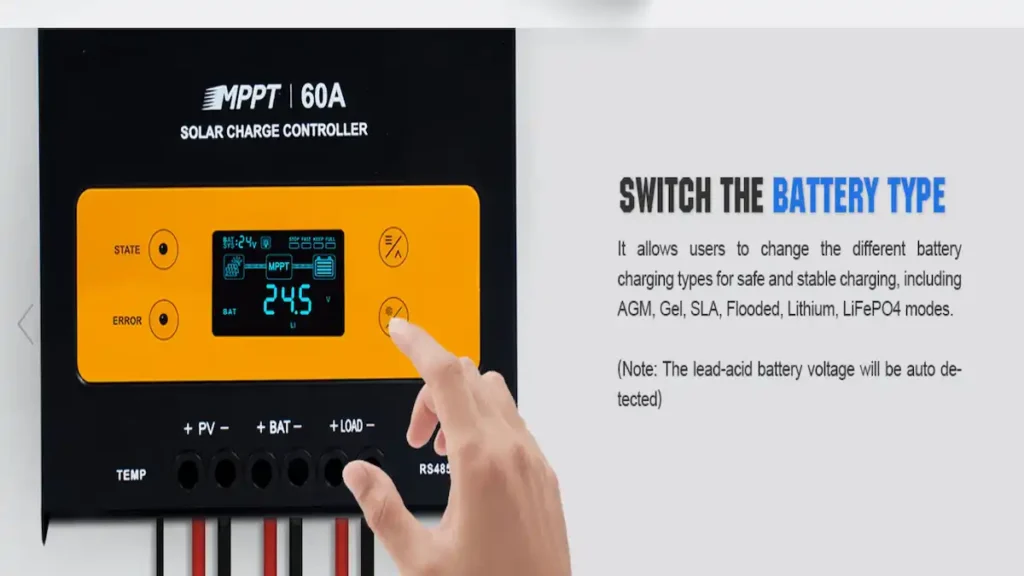
Whether you’re using Gel, AGM, Lithium, LiFePO4, Flooded, or even NCM/NCA batteries, Eco-Worthy’s controllers have you covered. They can charge and discharge battery banks at 12, 24, 36, or 48 volts, adapting seamlessly to your specific battery chemistry and system setup.OLED Screen for Real-Time Monitoring
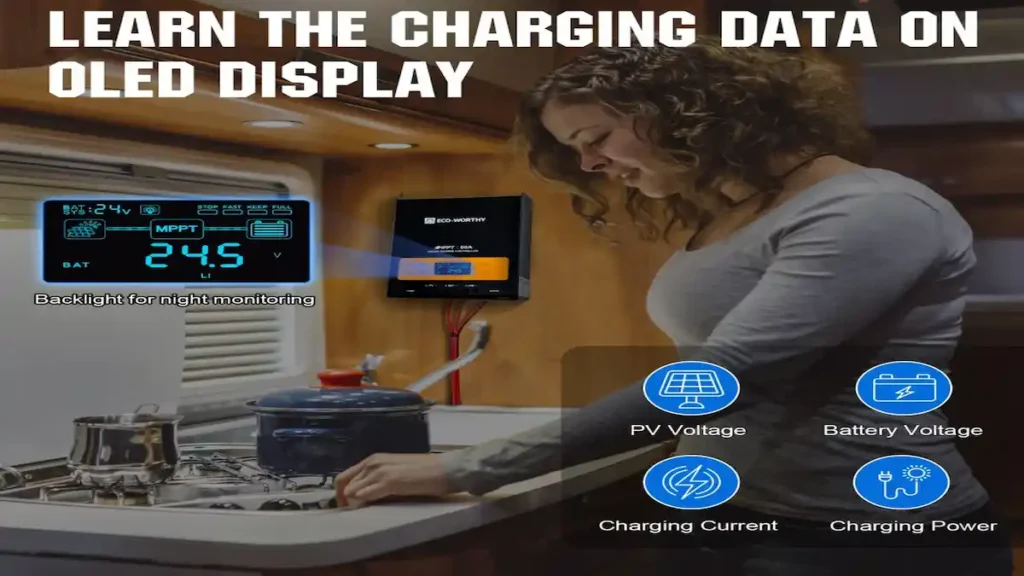
The built-in OLED display provides clear, at-a-glance information on PV voltage, battery voltage, charging current, and charging power. Plus, intuitive buttons allow you to switch battery types easily, giving you full control and peace of mind.
Advanced Safety Features
Safety is a top priority with Eco-Worthy’s controllers. They include multiple electronic protections to guard against Reverse Polarity, Short Circuits, High Temperature, Over-Current, and Over-Voltage or Low-Voltage conditions. These safeguards protect your system from damage and prevent dangerous situations like explosions or fires.
In summary, Eco-Worthy’s solar charge controllers offer a perfect blend of advanced technology, wide compatibility, and robust safety features. If you want a dependable, high-efficiency controller to maximize the performance of your solar power battery charger and extend your system’s life, Eco-Worthy is an outstanding choice.
How to choose the best solar charge controller to suit your requirements
Here are some key points to keep in mind while choosing a controller:
- Match the Voltage: Make certain your controller’s voltage is identical to your system (12V, 24V, or 48V).
- Check the Amperage: The controller needs to manage how much current your solar panels generate.
- Consider Your Battery Type: Different batteries (lead-acid, lithium-ion, AGM) require different charging profiles.
- Compatibility with Your Solar Power Battery Charger: If you use a separate charger, your controller will need to be compatible with it.
Frequently Asked Questions
Do I Need a Charge Controller for a 100W Solar Panel?
Yes, you’ll want a charge controller with a 100W solar panel. The main job of the controller is to manage the voltage and current from the panel to the battery, which keeps the battery from overcharging and getting damaged in the long run.
A 100W panel under full sun can put out 18 to 22 volts—way more than a standard 12V battery should handle. Without a charge controller, you risk overcharging, overheating, and shortening your battery’s life.
A small 10A charge controller is usually enough to keep things working safely and efficiently with a 100W panel.
Can I Connect Solar Panels Directly to a Battery?
Technically, you can connect a solar panel straight to a battery. But honestly, it’s not a good idea for most setups. If you skip the charge controller, the panel keeps sending power even when your battery is already full.
That leads to overcharging, overheating, and a battery that doesn’t last nearly as long. Over time, it can wreck the battery altogether.
Some very small trickle-charging panels go straight to a battery with no problem, but if you’re using a 100W panel or anything larger, always use a charge controller to manage the charge.
How Many Solar Panels Can a 40A Charge Controller Handle?
This depends on both your system voltage and the total wattage of all your panels.
For most setups:
- With 12V—plan on about 500 to 600 watts of panels
- With 24V—about 1000 to 1200 watts
- With 48V—up to 2000 watts or more
If you’re putting together a 12V setup, a 40A controller can usually run five or six 100W panels safely. Just make sure to check the controller’s max input voltage and power rating before connecting everything.
What Happens If a Charge Controller Is Too Small?
If your charge controller can’t handle all the current coming from your panels, it might overheat, shut down, or even get damaged. An undersized controller hurts your solar system’s efficiency and can keep your batteries from charging the way they should. In some cases, it can even cause failures or kill the controller early.
To play it safe, pick a controller that’s 20–30% bigger than your calculated solar panel output. This way, you won’t have any trouble when sunlight is at its peak.
How Long Do Solar Charge Controllers Last?
Most solar charge controllers last anywhere from 5 to 15 years. The lifespan depends on build quality and where you install them. Top-notch MPPT controllers tend to last longer since they use better electronics and cooling. How you install the controller matters, too. Put it in a cool, dry spot with good airflow, and you’ll help it avoid overheating and electrical issues.
Is MPPT Better Than PWM for Small Solar Systems?
MPPT controllers are more efficient than PWM types because they convert extra panel voltage into more charging current, sometimes improving efficiency by 10–30%. But PWM controllers are much cheaper and work well for small setups—like a system with just one or two panels. For a basic 100W panel, you’re usually fine with PWM. If you want a larger or more complex system, or plan to expand down the road, MPPT is a better call.
Closing Thought
Protect Your Investment with the Appropriate Controller Your solar charge controller might seem like it occupies a minor role in your solar array, yet it is one of the most important. It protects your batteries, maximises your systems efficiency, and provides you with the optimal output from your solar power battery charger. The right kind — either MPPT or PWM — to opt for is a matter of your aspirations, system size, and budget. Spend some time understanding your needs, and you will end up saving money and hassle down the line.
Author

Top Solar Picks is a team of solar enthusiasts and renewable energy researchers with hands-on experience testing solar generators, panels, and battery storage systems.