
Let’s get right to it on Top Solar Picks: the amps you get from a solar panel come down to two things—how many watts the panel has, and what voltage your solar setup uses. There’s a simple formula for this:
Amps = Watts ÷ Volts
So, grab a 100-watt solar panel and hook it up to a 12-volt system—now you’re looking at about 8.3 amps, if the sun’s shining bright and everything is just right. Double that to a 200-watt panel on the same system, and you’ll get around 16.6 amps. Keep in mind, though, these numbers look great on paper. Real-world results almost always come in a bit lower because, well, weather and life happen.
Why does any of this matter? Knowing how watts, volts, and amps connect helps you figure out what size wires, batteries, and charge controller you actually need. Too small, and you risk overheating stuff. Too big, and you waste money.
Why System Voltage Changes Your Solar Panel Amps
Solar setups usually run on 12V, 24V, or 48V systems. Here’s the catch: while your panel’s wattage stays the same, the amps shift with the voltage. remember this equation:
Watts = Volts × Amps
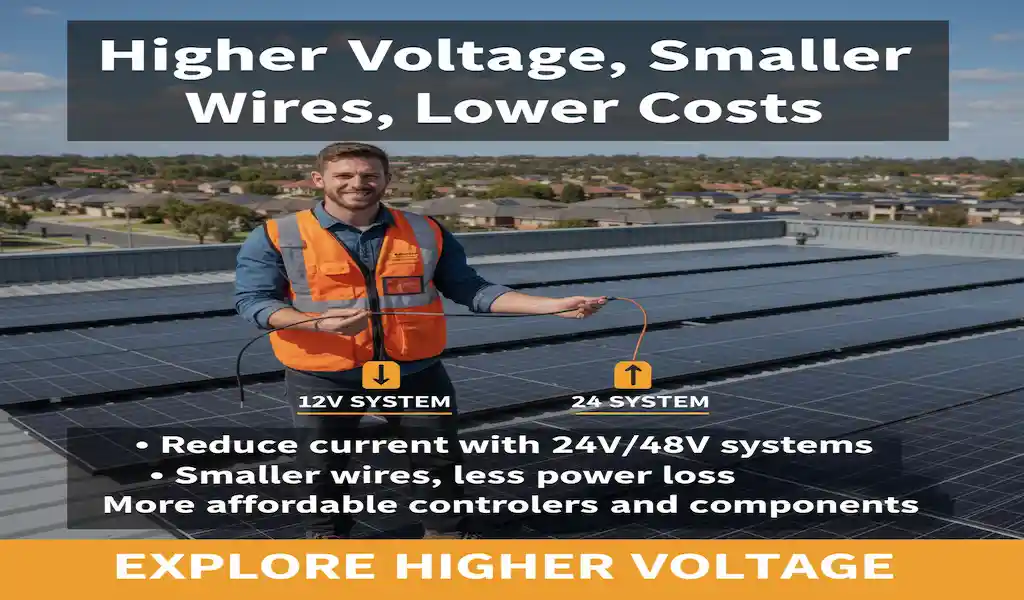
Crank up the voltage, and you need fewer amps to deliver the same power. That’s why high-voltage solar systems are more efficient. Less current means less energy lost as heat in your wires.
Take a 200-watt panel. On a 12V system, you’ll see about 16.7 amps. Switch to 24V, and it drops to 8.3 amps. Move up to 48V, and you’re down to just 4.2 amps. You still get 200 watts—it’s just that the current falls as the voltage rises.
That lower current is a big deal in larger systems. Wires run cooler, and you don’t have to shell out for extra-thick cables. That’s why bigger home solar setups usually skip 12V and go straight to 24V or 48V.
Solar Panel Amps by Size
Most home and off-grid solar setups use panels somewhere between 100 and 400 watts. The amps they crank out depend on your system voltage. Let’s break it down:
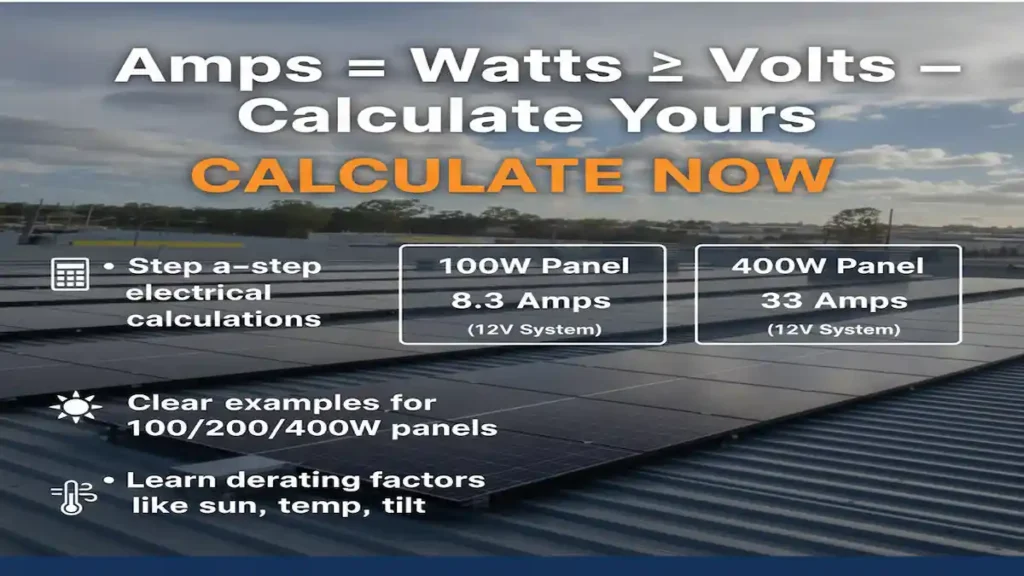
- – A 100-watt panel on a 12V system makes about 8.3 amps. On a 24V system? About 4.2 amps. Bump it up to 48V, and you’re looking at closer to 2 amps. In real life, especially on a hot day or with some clouds, you’ll probably see 6 to 7 amps from that 100-watt panel at 12 volts during peak sun.
- – A 200-watt panel basically doubles those numbers. Think about 16.7 amps at 12V, or 8.3 amps at 24V.
- – Modern home setups often use 400-watt panels. Those can kick out up to 33 amps at 12V, 16–17 amps at 24V, and around 8 amps at 48V.
One thing to know: many big panels actually run at higher voltages inside, so they usually put out 10 to 13 amps at their peak, depending on the panel design.
The Hidden Factors That Make (or Break) Your Solar Panel Performance
Manufacturers test solar panels under perfect lab conditions: 25°C (77°F) and strong, steady sunlight. Out in your backyard or on your roof, things are rarely so perfect. That’s why the actual current is usually lower than the rated value.
Sunlight is the biggest factor. You’ll get the most juice at midday, on a clear day, with the sun high in the sky. Shadows, clouds, or even a bit of dirt will drop your panel’s output fast.
Temperature matters too. As panels heat up, their voltage drops a bit, which means less power overall. Most panels lose about 0.3% to 0.5% for every degree Celsius above 25°C.
Direction, tilt, and dust or grime on the glass also cut efficiency. With all these variables, most solar systems end up running at about 70–80% of their rated capacity in real-world conditions.
Why “12V Solar Panels” Aren’t Actually 12 Volts
Here’s a funny thing: a “12V” solar panel doesn’t really make 12 volts. It’s usually up around 17 to 20 volts at its peak power point (Vmp).
Why? The panel’s voltage has to beat the battery’s voltage, or charging just won’t happen. If your panel only put out 12 volts, it couldn’t push current into a 12V battery.
Same goes for bigger setups. Panels for 24V systems usually run at 34 to 40 volts, and panels for even higher voltage systems go higher still.
How Solar Panel Amps Decide Your Charge Controller Size
The current your solar panels crank out decides what size charge controller you need. The controller’s job? Handle the highest possible current your panels can deliver, no sweat.
Most installers stick to a simple formula:
Controller Amps = (Total Solar Watts ÷ Battery Voltage) × 1.25
That extra 25% acts as a buffer. On sunny days when your panels hit their peak, you don’t want your controller struggling to keep up.
Let’s look at an example. Say you’ve got a 400-watt panel on a 12-volt battery. That setup gives you about 33 amps. Throw in the safety margin, and you’re looking at a controller rated for around 42 amps. So, you’d pick a 40-amp or 45-amp charge controller—either works.
Switch to a 24-volt system with the same panel, and your current drops to about half. Now you can go with a smaller controller.
Here’s What Matters
The amps your solar panel puts out depend on its wattage and your system’s voltage. Just use the formula: Amps = Watts ÷ Volts. It’s quick, and it gives you a solid estimate for any panel.
A 100-watt panel on a 12-volt system gives you roughly 8 amps. Bigger panels—200W, 400W—just scale up from there. Of course, what you get in the real world usually falls a bit short because of heat, clouds, or whatever else nature throws at you.
Bottom line: Knowing how many amps your panels produce isn’t just a nice detail. It’s crucial for picking the right charge controller, choosing the right wire size, and making your whole solar setup run smoothly.
Author

John Tanko is the founder of Top Solar Picks and a solar energy researcher whose work has been featured in leading technology and sustainability publications. Learn more on our About page.