
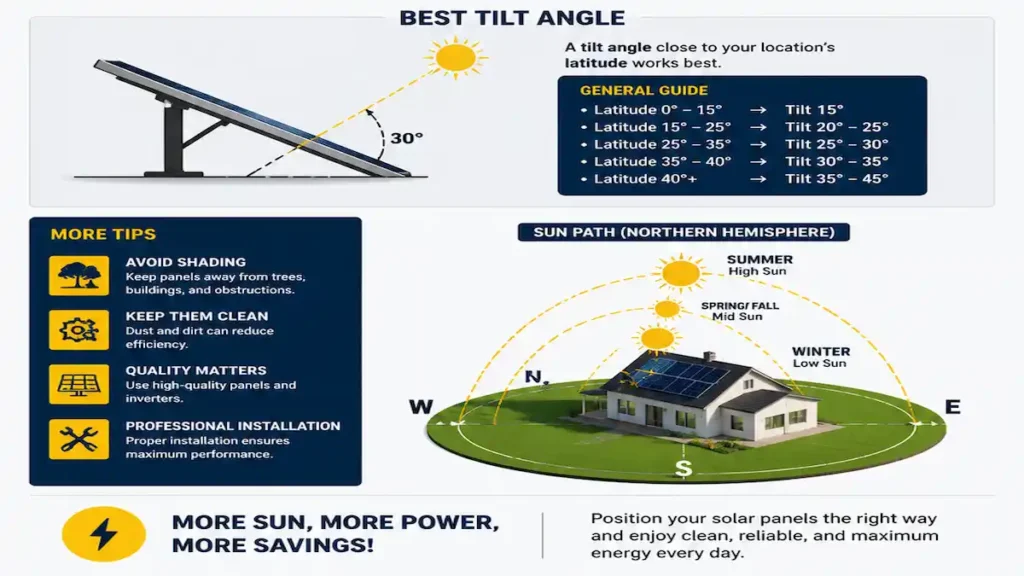
Choosing the best direction for solar panels is one of the most important factors in maximizing solar energy production. Even high-efficiency panels can lose a noticeable amount of power if they are installed facing the wrong direction. In some cases, poor orientation can reduce electricity output by 20% or more over the lifetime of the system.
That matters even more in 2026 as electricity prices continue rising and homeowners expect better long-term savings from solar investments. The good news is that finding the right solar panel direction is usually simpler than most people think once you understand how sunlight moves across your roof during the day.
For most homes, south-facing solar panels deliver the highest energy production. However, east- and west-facing panels can sometimes provide better financial returns depending on your electricity usage patterns, local utility rates, and when your household consumes the most power.
The Best Direction for Solar Panels
If you’re in the Northern Hemisphere—think the US, Canada, the UK, most of Europe—solar panels usually work best when they face true south. In the Southern Hemisphere, it flips, and true north is the way to go.
That setup helps your panels grab as much direct sunlight as possible from sunrise to sunset. More sunlight means more energy each year, which usually means you’ll see payback sooner.
One thing a lot of people miss: “true south” isn’t the same as “magnetic south.” Your phone’s compass or a regular compass points to magnetic south, but that can be a little off compared to the sun’s real path, depending on where you live. Most modern installers sort this out for you when they design the system, but it’s still good to know when you’re looking at your own roof.
How Much Does Direction Affect Solar Output?
The direction your panels face has a direct impact on how much electricity they generate over the course of a year. South-facing systems remain the benchmark because they receive the most balanced sunlight exposure from morning through evening.
Here’s how different directions typically compare in the Northern Hemisphere:
| Direction | Estimated Annual Output |
|---|---|
| True South | 100% |
| Southeast / Southwest | 92–96% |
| East | 80–88% |
| West | 80–87% |
| North | 60–75% |
These numbers vary depending on climate, roof pitch, and shading, but the overall pattern stays fairly consistent across most regions.
Many homeowners are surprised to learn that southeast- and southwest-facing roofs still perform very well. In fact, the production difference is often small enough that it doesn’t significantly affect the financial value of the system.
East- and west-facing solar panels are also far from useless. While they generally produce less total electricity than south-facing systems, they can still generate strong savings — particularly in areas with time-of-use electricity pricing.
Why West-Facing Panels Can Sometimes Be Better
Maximum energy production is not always the same thing as maximum savings.
In states with time-of-use utility plans, electricity becomes more expensive during late afternoon and evening hours when demand rises. West-facing solar panels produce more electricity during those high-cost periods, which can sometimes offset utility bills more effectively than a south-facing system.
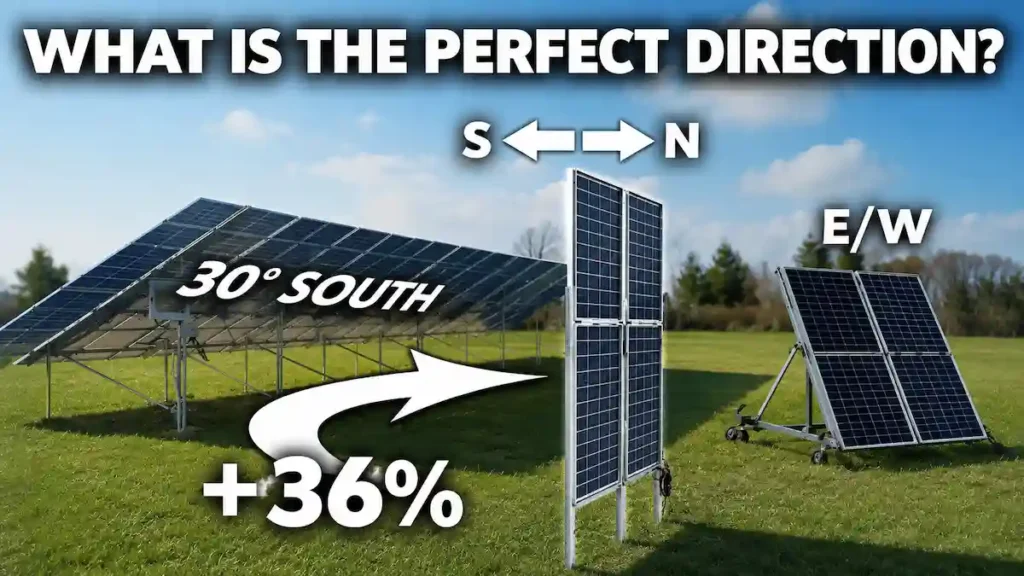
For homeowners who use most of their electricity after work — running air conditioning, appliances, lighting, or charging electric vehicles in the evening — west-facing solar can actually align better with real household energy consumption.
This is one reason modern solar design has become more customized in recent years. Installers now optimize systems not only for raw production, but also for actual utility savings and long-term value.
The Importance of Tilt Angle
Direction gets most of the attention, but tilt angle also plays a major role in solar performance.
In general, the ideal tilt angle is close to your geographic latitude. A home in New York, for example, benefits from a steeper tilt than a home in Florida because the sun sits lower in the sky for much of the year.
Most residential roofs already fall within a reasonably effective range, which is why installers rarely modify roof angles unless the difference is extreme. A perfectly optimized tilt can improve production slightly, but avoiding shading is usually far more important than chasing the exact ideal angle.
Some ground-mounted systems use adjustable racks or solar trackers that follow the sun throughout the day. These setups can increase production significantly, but they also add cost and maintenance, making them less practical for many residential installations.
Shading Often Matters More Than Direction
One of the biggest misconceptions about solar is that direction alone determines performance.
In reality, shading can have an even larger impact.
A south-facing roof with regular shade from trees or nearby buildings may perform worse than a west-facing roof with full sun exposure. Even partial shading during peak production hours can reduce efficiency noticeably.
That’s why pros spend a lot of time looking at roof obstructions, nearby trees or buildings, and how sunlight hits throughout the year before they design a system. Picking the right solar setup is almost never about just one thing.
Are East- and West-Facing Solar Panels Still Worth It?
Definitely.
Today’s solar panels are way more efficient than ten years ago, and inverters have come a long way, too. With microinverters or power optimizers, modern systems handle panels on different parts of your roof much better than older setups ever could.
These days, a lot of new homes spread panels over several roof surfaces instead of just one south-facing section. East-west facing panels usually deliver a steadier energy curve all day, which tends to fit household electricity use better and means you don’t have to lean as much on battery storage.
If you don’t have much space facing south, this method actually helps generate more usable solar power overall.
Good Example
Here’s a realistic comparison for a typical 6 kW residential solar system in the Midwest US:
| Panel Direction | Estimated Annual Production |
|---|---|
| South-facing | 8,500–9,500 kWh |
| Southwest-facing | 8,000–8,900 kWh |
| East-facing | 7,300–8,100 kWh |
| West-facing | 7,200–8,100 kWh |
| North-facing | 5,500–7,000 kWh |
Even west-facing systems can still provide excellent savings depending on utility rates and household energy usage.
How to Find the Best Direction for Your Home
The simplest way to check your solar potential is with online tools like PVWatts from the National Renewable Energy Laboratory.
You can also try Google Project Sunroof.
These tools estimate solar potential based on your roof direction, local weather conditions, and sunlight exposure.
Still, no online calculator replaces a professional assessment. A qualified installer can model shading, roof pitch, panel layout, and expected annual production with much greater accuracy.
Common Myths About Solar Panel Direction
One of the most common myths is that solar panels are only worthwhile if they face south. That may have been closer to true years ago, but modern systems remain highly effective even with east- or west-facing roofs.
Another misconception is that homeowners need to constantly adjust panel angles throughout the year. While seasonal tilt adjustments can improve production slightly, most fixed residential systems already perform extremely well without ongoing adjustments.
There’s also a belief that north-facing panels are completely useless. In reality, they still generate electricity — just at a noticeably lower level in the Northern Hemisphere.
Frequently Asked Questions
What direction should solar panels face for maximum power?
In the Northern Hemisphere, solar panels produce the most electricity when facing true south. In the Southern Hemisphere, true north gives the best overall yearly performance.
Are west-facing solar panels worth it?
Yes. West-facing panels can still perform very well, especially in areas with time-of-use electricity pricing where power is more expensive in the evening. They often align better with household energy usage after work hours.
How much efficiency is lost with east-facing solar panels?
East-facing systems usually generate about 12–20% less energy annually compared to an ideal south-facing setup. However, actual performance depends on location, shading, and roof angle.
Can solar panels face north?
Yes, but north-facing panels are the least efficient in the Northern Hemisphere. They are typically only used when no other roof direction is available.
What is the best tilt angle for solar panels?
The best fixed tilt angle is usually close to your geographic latitude. This gives a strong balance of summer and winter performance for most homes.
Does shading matter more than direction?
In many cases, yes. Even a perfectly south-facing system can lose significant output if it is shaded during peak sunlight hours. A clear roof is often more important than perfect orientation.
Do solar panels need seasonal adjustment?
Most residential systems use fixed mounting and do not require seasonal adjustment. While adjusting tilt can slightly improve performance, the gain is usually small compared to the added effort.
Final Thoughts
For most homeowners in 2026, south-facing solar panels remain the best option for maximum yearly energy production. That orientation still delivers the strongest overall performance in the Northern Hemisphere.
But the real-world answer is often more nuanced than simply pointing panels south.
Your roof shape, shading, electricity usage habits, utility pricing structure, and available installation space all play a role in determining what setup makes the most financial sense. In many cases, a slightly imperfect orientation paired with quality equipment and thoughtful system design will still deliver excellent long-term savings.
Solar technology has advanced to the point where homeowners now have far more flexibility than they did in the past. Even if your roof isn’t perfectly positioned, there’s a good chance solar can still work extremely well for your home.
Before making a final decision, it’s worth comparing estimates from multiple installers and using tools like PVWatts to understand how different layouts affect production. Small design improvements today can translate into years of additional energy savings later on.
This article is for informational purposes only and should not replace advice from a licensed solar professional familiar with your property and local conditions.
Author

John Tanko is the founder of Top Solar Picks and a solar energy researcher whose work has been featured in leading technology and sustainability publications. Learn more on our About page.