
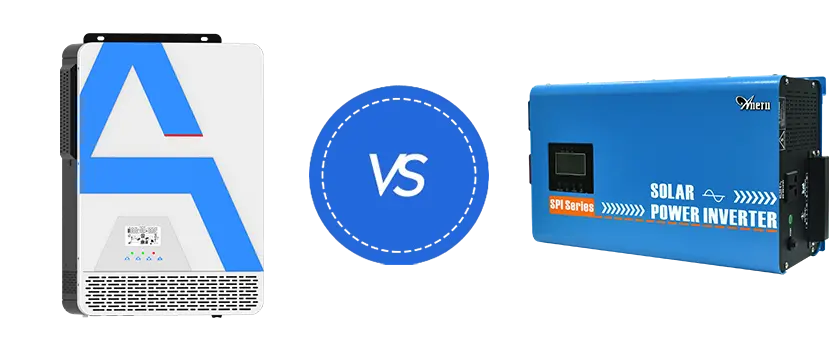
Image by Anern
One of the biggest decisions when choosing an inverter for a home, RV or solar home is the choice between high frequency inverter vs low frequency inverter. Each has its benefits, and a poor choice can affect efficiency, performance, and long-term costs. This guide will show you what you need to know and answer common questions buyers from tier 1 countries such as US, UK, Canada and Australia, are asking.
What are the differences between high frequency and low frequency inverters?
What is High-Frequency Inverter?
A high-frequency inverter constructs its pn junction using modern electronic components and light ferrite core transformers to change DC to AC power. They are also compact, highly efficient, and popular among homes, RVs, and portable solar systems utilizing pure sine wave inverter configurations. Portability and efficiency are often why they are picked for RV inverter systems.
High-frequency inverters this is the characteristics:
- Compact and lightweight designs.
- The switching frequency is higher (typically > 20kHz).
- Efficient, Cost effective for small to medium scale power requirements.
What is a low-frequency inverter?
Low-frequency inverter utilize bigger iron-core transformer resulting in big and heavy. But this also means they are more capable of sustaining higher power bursts and continuously heavy loads, so they’re ideal in hybrid solar inverter systems, full off-grid solar, or home and business battery backup systems.
Low frequency inverter is one of such inverters which can be characterized as:
- Durability and robust design.
- Reduced switching frequency (i.e. usually less than 500Hz)
- Capable of switching on inductive loads such as motors and compressors.
1. The similarities between low frequency and high frequency inverters
Low Frequency Inverter
High Frequency Inverter
Inverters come in two common varieties: high frequency inverter and low frequency inverter. Their operating principles, application scenarios, and performance characteristics differ and are similar in certain ways. These are the parallels:
Function:
Converting DC electricity into AC power to satisfy certain application requirements is the shared objective of both high frequency and low frequency inverters.
Waveform output:
Both high frequency and low frequency inverters can produce AC signals in a variety of shapes, including sine waves (like the TYCORUN 2000w pure sine wave inverter and the power inverter 3000w), square waves, or pulse waves, depending on the needs of the application.
Application fields:
Power systems, solar power generation, UPS systems, electric drives such as those that use trolling motor batteries, and other fields make extensive use of both types of inverters. The right type of inverter ( high frequency inverter vs low frequency inverter) must be chosen based on the needs of the particular application, taking into consideration elements like its frequency characteristics, efficiency requirements, size and weight requirements, etc.
2. Efficiency and Power Handling: Which One is Better?
Efficiency of High-Frequency Inverters
- Usually >90% conversion efficiency
- Best for light to medium loads like laptops, TVs and small kitchen appliances.
- Perfect for portable solar inverter with charger setups and mobile applications where weight and compact size are essential.
Efficiency of Low-Frequency Inverters
Handle continuous heavy loads like industrial appliances, air conditioners, and pumps.
Better suited for whole-house systems and industrial applications.
Lower efficiency (80% to 88%) compared to high-frequency inverters but more stable under high surge conditions.
3. Durability & Life Expectancy: Which Inverter Has Better Life?
- High-frequency and inverters thus have a market-short, but also heat sensitive components giving them between 5 to 10 years of lifespan.
- The average lifespan of low-frequency inverters is from 10-20 years, due to their strong inability to run on lower frequencies and dissipate heat more effectively.
- The low-frequency is preferred for use with home solar for long-term setups, RV, and temporary applications, high-frequency is good enough for your needs.
4. Cost Consideration: Does a Low-Frequency Inverter Justify Its Price?
| Feature | High-Frequency Inverter | Low-Frequency Inverter |
|---|---|---|
| Initial Cost | Lower ($150 – $600) | Higher ($500 – $3,500) |
| Maintenance | Minimal | Requires occasional servicing |
| Lifespan | 5-10 years | 10-20 years |
| Power Handling | Light to medium loads | Heavy and inductive loads |
| Portability | High | Low |
Conclusion: High-frequency inverters are budget-friendly for portable and smaller systems, whereas low-frequency inverters are an investment for long-term, heavy-duty applications.
5. Best Use Cases: Which Inverter is Right for Your Needs?
Use a High-Frequency Inverter If:
- For camping or van life, you need a portable RV inverter.
- Solar and power inverter system: Compact and lightweight components are the need of the hour.
- Your power consumption is below 2000W.
Use A Low-Frequency Inverter When:
- For an off-grid home, you want to provide high power demands of solar panels through an inverter.
- You operate air conditioning units, refrigerators, industrial equipment and water pumps.
- You include hybrid solar inverter setups with battery storage, along with grid tie.
6. Grid-Tied vs Off-Grid Considerations
- These types of inverters are better suited for Mounting grid connected solar with Cost effective, electrical energy conversion.
- Low frequency inverter is used for off grid system or application with many power outages for good backup and reliability.
7. How to Select the Best Inverter for Solar and RV Needs
Best High-Frequency Inverter in 2025
Renogy 2000W Pure Sine Wave Inverter — Best for RV and portable solar setups.
AIMS Power 3000W Inverter — Compact and efficient for medium home setups.
The Best Low Frequency Inverters of 2025
Growatt SPF 5000 ES Hybrid Solar Inverter — Perfect for full home solar with backup.
Victron Energy Multiplus 5000VA — High-end solution for off-grid living and industrial needs
Frequently Asked Questions (FAQs)
What is the ideal inverter for home use?
If you use power-hungry items (like air conditioners and pumps) at home, a pure sine wave inverter with low-frequency characteristics should be your go-to.
Can I install a high-frequency inverter for solar panels?
Yes, although it’s more favorable for small-scale solar installations. Low-frequency inverters are comparably more rugged for larger homes and for commercial applications.
What is a hybrid solar inverter compared to a normal inverter?
While standard inverters only convert direct current (DC) energy into alternating current (AC) energy, hybrid solar inverters combine solar energy management, grid interaction, and battery storage into one device.
Which inverter is best for RVs?
Higher frequency RV inverters are leaner and smaller, making them ideal for mobility power applications.
Are low-frequency inverters better at withstanding surges?
Yes, low – frequency inverters will handle large surge loads (such as motor starting) much better.
More Takeaways for Tier 1 Viewers (US, UK, Canada, Australia)
If you are from Tier 1 nations and are looking for a dependable inverter for home and solar backup, consider the long-term scenarios. Low-frequency inverters are used for whole-house solar systems with battery storage, whereas high-frequency inverters are used for mobile, RV use and light home use.
Wrapping it Up: Picking 2025
When it is to choose high-frequency vs low-frequency inverters, it all depends on knowing your energy requirements. Go high frequency for compact, low-cost systems. For tough systems with significant load, low frequency is your friend
Author

John Tanko is the founder of Top Solar Picks and a solar energy researcher whose work has been featured in leading technology and sustainability publications. Learn more on our About page.