
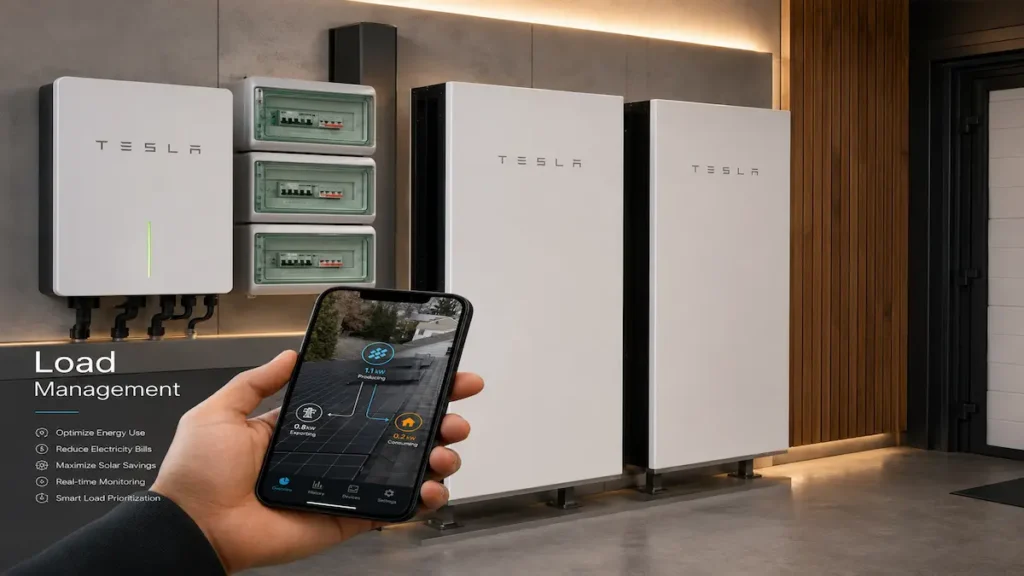
If you’ve been wondering why your solar battery drains fast or why your solar battery doesn’t last all night, you’re not alone. Many homeowners assume that buying a bigger battery will solve every power problem, but the truth is often much simpler.
In most cases, poor load management—not the battery itself—is the real reason backup power disappears sooner than expected.
The good news is that you don’t always need to spend more money on a larger battery. By understanding when to use electricity and how to make a solar battery last longer, you can significantly improve backup time and get more value from your solar investment.
In this guide, you’ll learn why heavy appliances should be used during the day, how your energy habits affect battery life, and the simple changes that can keep your lights on for longer.
The Biggest Reason Your Solar Battery Doesn’t Last All Night
One of the biggest problems with solar power around the world is poor load management. A solar professional may advise you to run heavy appliances during the day, but many homeowners ignore that advice because they believe a large battery can handle everything. They say, “I bought a 20kWh battery, so why should I worry?” Unfortunately, electricity doesn’t work that way? They will say, but my battery is 20 kilowatt-hour and I paid 8.5 million.
Yes, you paid, but physics did not collect your money. Now, let me explain in better language. Solar panels generate energy when the sun is available.
Battery stores limited energy. The inverter distributes power when it is available. So battery is not grid or generator. If you exhaust it, it will go off. Not because solar is a scam, but because energy is finite.
Now, if your nighttime load is three ACs, fridge-freezer, microwave, just know that you are consistently consuming 6 to 7 kilowatts. Simple math, your battery capacity, which is 20 kilowatt-hour, divided by 6 kilowatts, 3 hours. Period. After that, darkness. And you will not say battery is not good. No, sir, the real problem is you because you refuse to do load management.
Solar is not just installation, it is behavior. Do you know that the people that enjoy solar the most is because they understand energy budgets.
But you see the ones that like to complain, they use battery like they are trying to prove a point. In a nutshell, solar is not a scam. Energy ignorance is. If you use it well, it will unbolt generators silently. If you want to learn more about the solar business, make sure to follow our Facebook page
Why Heavy Appliances Should Be Used During the Day Whenever Possible
One of the smartest ways to make your solar battery last longer is to schedule heavy electricity usage while the sun is shining. During the day, your solar panels are actively generating power, allowing appliances to run directly from solar energy instead of relying entirely on the battery.
For example, using your washing machine, water pump, electric iron, microwave, or electric cooker in the afternoon means much of the required electricity comes straight from your panels. This reduces the amount of energy pulled from the battery and leaves more stored power available for nighttime essentials such as lighting, televisions, fans, and refrigerators.
Many homeowners make the mistake of saving all their heavy tasks for the evening because they’re home from work. Unfortunately, that’s also when the solar panels stop producing electricity and every high-power appliance starts drawing directly from the battery. The result is faster battery depletion and shorter backup times.
Think of your battery as your emergency reserve rather than your primary power source. The more work your solar panels can do during daylight hours, the less strain you place on the battery after sunset. This simple habit not only extends battery life but can also reduce wear and improve the overall efficiency of your solar system.
If your goal is to stop wondering why your solar battery drains so fast, shifting heavy appliances to daytime operation is one of the easiest and most effective changes you can make.
Best Time to Run Common Household Appliances
This reinforces your load management advice.
| Appliance | Best Time to Use | Reason |
|---|---|---|
| Washing Machine | Daytime | Uses direct solar power and reduces battery consumption. |
| Water Pump | Daytime | Runs on energy generated by the solar panels instead of stored battery power. |
| Electric Iron | Daytime | High power consumption can quickly drain batteries if used at night. |
| Microwave | Daytime | Minimizes battery drain by using available solar energy. |
| Electric Cooker | Daytime | One of the heaviest household loads and is best powered directly by the sun. |
| Air Conditioner | Daytime or Limited Night Use | Can quickly deplete battery reserves when used continuously after sunset. |
| Refrigerator | 24/7 | An essential appliance designed to run continuously. |
| Lighting | Night | Generally consumes relatively little electricity compared to heavy appliances. |
| TV & Laptop | Night | Lower power consumption makes them suitable for battery operation. |
Why Your Solar Battery Drains So Fast
One of the biggest misconceptions about solar power is that installing a large battery means you can use electricity however you like throughout the night. In reality, your battery only stores a fixed amount of energy, and how quickly that energy disappears depends almost entirely on your daily habits.
If your battery seems to run out before morning, the problem is often not the battery itself but the amount of power your home is demanding.
Running several air conditioners overnight, leaving high-wattage appliances switched on, or using equipment like electric water heaters and microwaves after sunset can empty even a large battery much faster than expected.
Many homeowners also underestimate how much electricity they consume. a few devices running at the same time might not seem like a big deal, but all together, they can drain your battery way faster than you’d expect.
That’s why two houses with the exact same 20kWh battery can end up with totally different backup times. One family pays attention to what’s running, turns things off when they can, and stretches their battery hours. The other just uses power as usual and runs out much sooner.
Here’s the thing—your solar battery is just doing exactly what it’s supposed to do. It powers your home until it runs out of juice. Once it’s empty, that’s it. It won’t magically produce more electricity until your solar panels refill it during the day, or you plug in another charging source.
If you get this one idea, you’re already ahead. The way to make your battery last is to pay attention to how and when you use your power. With some simple changes, you’ll find you can count on your battery overnight—without blaming the solar system when it runs out.
How Long Does a 20kWh Solar Battery Really Last?
People ask this all the time, but honestly, there isn’t one simple answer.. If your home is consuming 2kW continuously, a 20kWh battery could theoretically last around 10 hours.
If your load increases to 5kW, the same battery may last only about 4 hours. and At 6–7kW of continuous demand, it may be depleted in roughly 3 hours. The battery capacity stays the same. What changes is how quickly you choose to use it.
Remember that these estimates assume a constant power draw. In real homes, electricity usage changes throughout the day as appliances switch on and off. Inverter efficiency, battery reserve settings, and temperature can also affect actual runtime, so your experience may differ from the theoretical calculations.
| Average Continuous Load | Estimated Runtime (20kWh Battery) |
|---|---|
| 1 kW | About 20 hours |
| 2 kW | About 10 hours |
| 3 kW | About 6.7 hours |
| 4 kW | About 5 hours |
| 5 kW | About 4 hours |
| 6 kW | About 3.3 hours |
| 7 kW | About 2.9 hours |
| 8 kW | About 2.5 hours |
Simple Ways to Make Your Solar Battery Last Longer
You don’t always need a larger battery. Sometimes you simply need smarter energy habits.
- Run washing machines and heavy equipment during daylight.
- Turn off appliances you’re not using.
- Use energy-efficient air conditioners and refrigerators.
- Avoid running multiple high-wattage devices at once.
- Monitor your daily electricity consumption.
- Plan your nighttime usage around your available battery capacity.
Small changes in behavior can add several hours of battery backup without spending another dollar on upgrades.
Solar Is Not a Scam—Poor Energy Management Is
Many people blame solar when the lights go off, but the real issue is often unrealistic expectations. A battery is designed to store energy, not create unlimited electricity. Whether you spend thousands or millions on your system, the laws of physics remain the same.
The homeowners who enjoy solar the most are usually the ones who understand their energy budget. They know when to consume, when to save, and when to let the sun do the heavy lifting.
In the end, successful solar ownership is less about buying the biggest battery and more about using the energy you have wisely.
Good vs. Poor Load Management
| ✅ Smart Load Management | ❌ Poor Load Management |
|---|---|
| Runs heavy appliances during the day | Runs heavy appliances all night |
| Monitors battery state of charge | Ignores battery level |
| Spreads out high-power usage | Uses many high-power devices simultaneously |
| Lets solar panels power daytime loads directly | Relies heavily on battery after sunset |
| Plans energy use based on available power | Assumes a bigger battery solves everything |

Why You Can Trust Top Solar Picks
We compare real-world solar performance, charging reliability, long-term user experiences, and practical testing — not just manufacturer claims. Products from brands like EcoFlow, Bluetti, Jackery, and Eco-Worthy are cross-checked using actual usage data and customer feedback.
Learn more →Frequently Asked Questions
1. Why does my solar battery drain so fast at night?
Your solar battery usually drains quickly because your home is using more electricity than the battery can supply for an extended period. Running multiple air conditioners, electric cookers, water heaters, or other high-power appliances after sunset can exhaust even a large battery in just a few hours. Proper load management is often the key to longer backup time.
2. Should I run heavy appliances during the day or at night?
Heavy appliances are best used during the day when your solar panels are actively producing electricity. This allows your home to use power directly from the sun instead of relying entirely on the battery. By shifting high-energy tasks to daylight hours, you can preserve stored energy for nighttime essentials.
3. How long should a 20kWh solar battery last?
The answer depends on your electricity consumption. A home using around 2kW continuously could theoretically get about 10 hours of backup, while a 6kW load may reduce runtime to around 3 hours. The more power your appliances demand, the faster the battery will discharge.
4. Can buying a bigger battery solve my load management problems?
Not always. A larger battery provides more storage, but it doesn’t eliminate the need for smart energy use. If you continue running several high-power appliances at the same time, even a bigger battery will eventually run out. Good load management and efficient energy habits are just as important as battery size.
Conclusion
If your solar battery keeps dying faster than expected, don’t assume the battery or the installer is the problem. In many cases, the real issue is how electricity is being used inside the home. Running heavy loads after sunset, ignoring your energy budget, and expecting unlimited backup from a finite battery will always lead to disappointment.
The good news is that the solution doesn’t necessarily require buying a larger battery. By understanding load management, using heavy appliances during the day, and planning your energy consumption more carefully, you can make your battery last longer and get better value from your solar investment.
Remember, solar isn’t about having endless power—it’s about using the power you have wisely. The homeowners who get the best results are usually the ones who treat energy as a resource to manage, not something to waste.
Before investing in a bigger battery, take a closer look at your load management. Small changes in when and how you use electricity can dramatically extend your backup time and save you money. If you found this guide helpful, explore more practical solar tips on Top Solar Picks.
Author

John Tanko is the founder of Top Solar Picks and a solar energy researcher whose work has been featured in leading technology and sustainability publications. Learn more on our About page.