
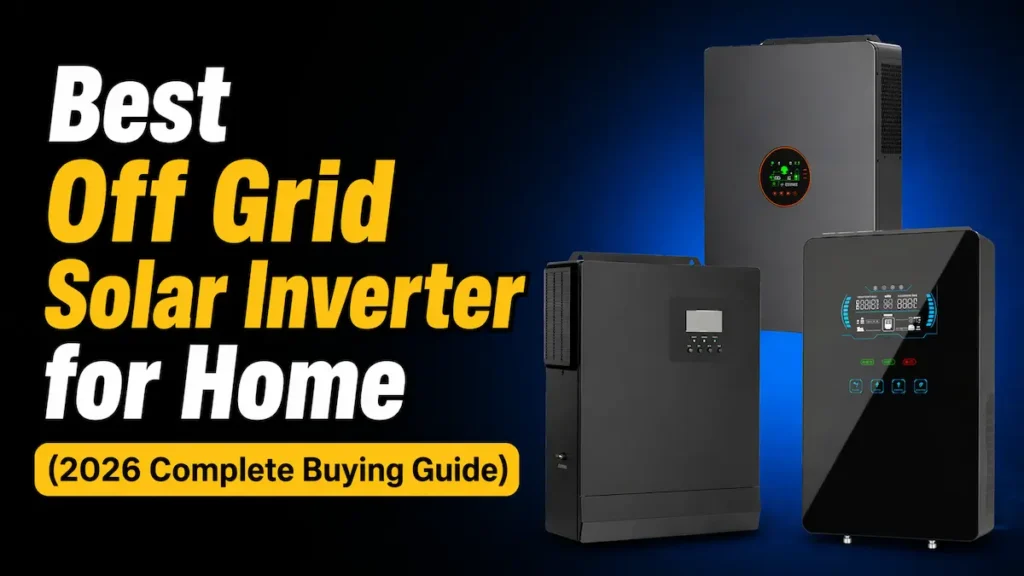
The Best off grid solar inverter for home use in 2026 depends on your power needs, battery setup, and budget. If you’re looking for the best off-grid solar inverter for your home in 2026, you’re likely trying to solve one of three problems: rising electricity costs, unreliable power, or the need for complete energy independence.
In this guide, we compare top-rated inverters explain how to choose the right size, and help you find the most reliable option for cabins, RVs, and full off grid homes and what you can realistically expect for price and performance in 2026. if you’re still deciding whether switching to solar makes sense financially, it’s worth reviewing the full cost-benefit breakdown in Is Solar Worth It in 2026?.
Best Off-Grid Solar Inverters (Quick Answer)
The best off-grid solar inverters for depends on your needs:
- Victron Energy MultiPlus – Best overall (premium performance & reliability)
- Growatt SPF 5000 ES – Best value with smart features
- Renogy 3000W Pure Sine Wave – Best for small homes & beginners
- Eco-Worthy 3500W – Best budget option
For most homeowners, the Growatt SPF 5000 ES offers the best balance of price, power, and smart features.
This guide on Off Grid Inverter was last updated by John Tanko on April 27, 2026, to ensure accurate and up-to-date information for homeowners, farmers, and off-grid users.
| Inverter Model | Best For | Power Output | Key Features | Price Range | Ideal User |
|---|---|---|---|---|---|
| Victron MultiPlus | Premium Overall performance | 3000W–5000W+ | Advanced battery management, remote monitoring | $$$$ | Full home / long-term off-grid |
| Growatt SPF 5000 ES | Best Value Smart features | 5000W | Built-in MPPT, WiFi monitoring | $$$ | Homeowners wanting balance |
| Renogy 3000W | Beginner Easy setup | 3000W | Reliable, compact, simple install | $$ | Cabins, small homes |
| Eco-Worthy 3500W | Budget Affordable | 3500W | Simple system, cost-effective | $ | First-time users / RVs |
The table above compares the best off-grid solar inverters based on power output, features, and pricing. For most homes, a 3000W–5000W inverter provides enough capacity for essential appliances and daily energy needs.
What Is an Off Grid Solar Inverter?
an off grid solar inverter converts your solar panels’ DC power into AC power to power lights, appliances, and electric devices. Unlike public power’s grid-tied power utilities but only independent of public power with the power stored in a set of deep cycle batteries for nighttime or non-sunny days use.
It is programmed to control solar energy generation, battery charging, and on-call power supply. MPPT charge controllers, battery overcharge protection, even remote monitoring are available as well. It’s all about supplying clean, safe energy flow—together with no contact whatever with the utility on site.
Think of it as a stand alone box that turns sunlight into electricity and manages your batteries at the same time. With one in place, your home can run all night—or through blackouts—without missing a beat.
How Off Grid Solar Inverters Work
When sunlight hits your panels, they start producing DC electricity. The problem is, your appliances need AC power. So, the inverter steps in, converting that DC juice into AC instantly. Any power you don’t use right away goes straight into your batteries.
Once the sun sets or your demand spikes, the inverter automatically draws energy from your stored battery power. There’s no flipping switches or fiddling around; the transition just happens, so the system feels smooth in daily life.
Modern inverters usually add smart features like MPPT tracking. That means they squeeze as much power as possible from your panels and keep your batteries safe from overcharging or deep discharge.
When you look at the full setup, the inverter is only one part of the system. Panels, batteries, and charge controllers all work together to keep your home powered. If you want a complete breakdown of how everything connects, see our guide on Off Grid Solar System: How It Works and What You Need to Know.
Why Off Grid Solar Inverters Are Worth It
The main reason people switch is control. Instead of relying on a power grid that may be expensive or unreliable, you generate and manage your own electricity. eventually, this cuts out—or at least shrinks—your monthly power bills. Plus, it solves the headache of blackouts messing with food storage, work, or comfort. For lots of homeowners, that peace of mind makes the investment easy to justify.
Financially, the benefits add up as you go. The upfront bill is steeper, but most systems break even in a handful of years. After that, the electricity you make is basically free.
Off Grid vs Grid-Tied vs Hybrid Inverters
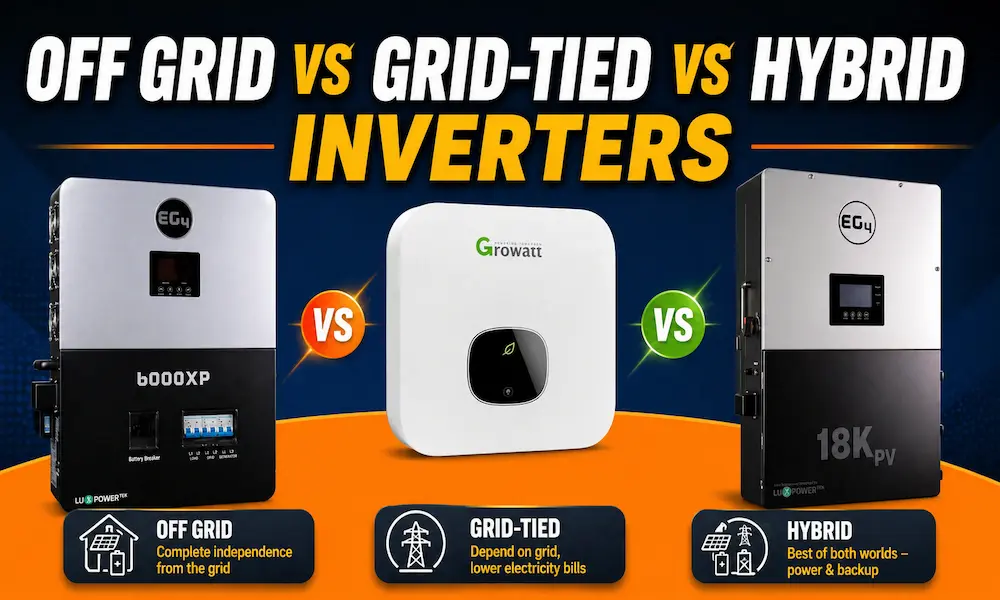
Off grid inverters work all by themselves—you need batteries, but you get true independence. Grid-tied systems lean on utility power. When the grid goes down, they usually shut off too, which isn’t great for reliability.
Hybrid inverters mix both options. You can use solar, stay hooked up to the grid, and have battery backup as well. They’re flexible, but usually pricier.
Best Off Grid Solar Inverters in 2026
When you’re picking an inverter, reliability matters most. Brands like Victron Energy have a reputation for lasting power and strong system features, especially in bigger setups.
If you’re starting small or just getting into solar, Renogy is a go-to—simple, easy to get, and works well. Growatt strikes a good balance between smart features and cost. Eco-Worthy is popular if you want to keep costs down.
At the end of the day, it’s less about brand and more about matching the inverter to what you actually need. If you want a deeper comparison of top-performing models, features, and real-world performance, you can check our full breakdown of Best Solar Inverters for Home Use (2026 Guide).
Choosing the Right Inverter Size
Sizing is where many systems fail before they even start. An inverter that is too small will struggle under load, while an oversized one increases cost unnecessarily. The correct approach is to calculate the total power demand of your appliances and then allow extra capacity for peak usage. In most cases, small setups work within the 1000W range, while full household systems typically fall between 3000W and 5000W.
Getting the size right also depends on how much solar energy you can generate daily. That’s why it helps to understand panel output and system sizing before choosing an inverter. You can use our breakdown on How Many Solar Panels to Power a House to estimate your actual energy needs.
Don’t forget about future plans, either. If you’ll add more panels or appliances, build in some breathing room.
Cost of an Off Grid Solar Inverter System
The cost of a complete off-grid system depends on size, the kind of batteries you use, and how tricky the install is. Smaller systems might run a few thousand bucks. Full-house packages can hit five figures.
While it’s a big upfront hit, it wipes out recurring power bills. Over a few years, the math often works out well, especially if power where you live is expensive or unreliable. the total cost of an off-grid setup also depends on installation, panel type, and system size. For a full cost breakdown, including real pricing examples, see How Much Does Solar Panel Installation Cost in 2026?.
Common Mistakes to Avoid
Most issues with off-grid systems come from poor planning planning—not hardware failures. If you pick the wrong inverter size, choose batteries that don’t match, or go cheap on components, you’ll see it in performance and system life.
Get the sizing right and do a good install, and your system should work smoothly for years.
Installation and Maintenance
To set everything up, you need to wire the solar panels, batteries, and inverter together safely. If it’s a small kit, you might handle it solo, but whole-home jobs are usually better left to a pro.
After that, maintenance is simple: keep the panels clean, check the batteries once in a while, and keep an eye on how the inverter’s running. Do that, and your system should chug along for years.
Benefits of Using an Off Grid Solar Inverter
Consider paying your entire annual electric bill for years with no revenue return for show. That’s what being a grid dependent achieves. Even with incentives layered in or incremental tiered rates, electric bills keep going up—but with no revenue return.
Then consider the purchase of an off grid inverter and solar system. Front-end buy and installation will give you a front-end initial expense—but then your energy is literally at no expense. In comparison with metering off the electric current supply grid, solar savers repay and keep saving you hundreds of thousands of dollars over centuries.
And consider reliability: blackouts ruin food, stop work, and ruin health equipment. Once you’re off-grid, you’re insulated from all those dangers—power is yours twenty-four/seven.
How We Evaluate Off Grid Solar Inverters (2026)
At Top Solar Picks, we don’t rely on specs alone. We evaluate off-grid solar inverters based on real-world performance, long-term reliability, and compatibility with complete solar systems.
Our analysis is based on:
We assess inverter efficiency under load, including how well it handles continuous and surge power from common household appliances. Battery compatibility is also a key factor, especially with LiFePO4 and lead-acid systems used in off-grid setups.
We look closely at built-in features like MPPT charge controllers, system protection, and monitoring capabilities, since these directly affect performance and lifespan. We also compare warranty terms and manufacturer reputation to identify brands that consistently deliver reliable products.
To support this, we review large volumes of user feedback across platforms and compare real-world usage patterns with manufacturer claims.
We do not accept payment to feature products. In some cases, we earn a commission through links, which helps us keep our content updated and independent.
Recommended Posts
- Off Grid Solar System: How It Works and What You Need to Know
- Can an Off Grid Solar System Power Your Home 100%? Real Costs and Setup Guide
- Best Solar Inverters for Home Use (2026 Guide): Hybrid, Off-Grid & Budget Picks
- Best Off-Grid Inverters for 2026 (Tested & Compared for US, UK, Canada)
- Eco-Worthy Solar and Power Inverter Guide (2026): Best 5000W Solar Inverters for Home & RV
The Top Benefits of an Off Grid Solar Inverter
• True Energy Independence
You decide when to power your home, not the power company.
• Long-Term Cost Saving
With zero monthly fees and the lifespan of solar panels usually more than 20 years, you repay your investment and save thereafter.
• Good for the Planet
You reduce carbon emissions and fossil fuel reliance. Solar is renewable energy, silent, and free.
• Scalable and Flexible
Begin small and scale large upon request. These systems generally become affordable to install turbines or more panels sometime in the future.
• Very Low Maintenance
With no internal mechanical parts in the inverter and simple panel cleaning, off-grid systems usually involve little maintenance. 10-25-year warranties are normally provided by the majority of manufacturers.
• Offsite Installations or Power Safety at Blackouts
Ideal for rural settings, cabins, or for anyone who doesn’t like blackouts.
Choosing the Right Off Grid Solar Inverter for Your Needs
The test parameters involved in testing an off grid solar inverter are:
1. Pure versus Modified Sine Wave
Select a pure sine wave if you power sensitive items such as laptops, refrigerator sets, or good quality lamps. A modified sine wave inverter becomes more affordable but cannot power cleanly on any piece of equipment.
2. Battery Compatibility and Protection
Look for inbuilt protection schemes—over-discharge, overcharge, and temperature protection—to extend the life of your battery bank.
3. Efficiency Ratings
High-efficiency inverters (maximum ~95%) waste less energy as heat. MPPT solar charge controllers charge solar panels to capture maximum power from the solar panels.
4. Scalability and Size
Ensure your inverter can meet your current needs and your future needs—some systems can be augmented with more batteries or panels.
5. Industry Reputation and Warranty
Purchase from companies which back their equipment with better service and 10-25 year warranties.
Our Best Off Grid Solar Inverters for 2026 Recommendations
These represent a couple of the most reliable and highly-recommended models for this year—ones which are suitable for an off-the-grid solar lifestyle:
Renogy 3000W True Sin Inverters with
Clean, reliable power in a small package. Can be used with multiple batteries types and is great for small off-grid cabins or mobile living.
Eco-Worthy 3500 W Off Grid
It’s a budget-friendly, tried-and-true unit for a small cabin, RV install, or first off-grid install. It has acceptable battery compatibility and is incredibly reliable for a unit at this price.
Victron Multi
A high-end unit with sophisticated battery charge management, remote visibility, automatic transfer with no transfer transients. Ideal for deep off-grid applications.
Growatt SPF 5000
Singles an MPPT charge controller with an inverter. Offers Wi-Fi monitor with LCD screen—a great fit for smart-controlled small-sized systems.
Between these options, Eco‑Worthy is the way to go if you’re new to this and want something dependable at an affordable price.

Explore the latest solar deals and discounts on trusted brands like Bluetti, EcoFlow, ECO-WORTHY, and Jackery. Browse solar generators, panels, and accessories at great prices.
View DealsHow Much Does an Off Grid Solar Inverter System Cost?
One can purchase an initial €10,000–€20,000 (or USD equivalent) for a small-to-medium off-grid package (with panels, batteries, and inverter But if your electricity bill was €150 per month (≈ €1,800 per annum). For 10 years, you’ve paid the utility €18,000. If your off-the-grid setup costs €12,000, you’d be even money 6–7 years down the line—and your power is literally free from then on. This does not include intangible advantages like blackout resilency, sustainibility, or energy independence.
Off Grid Solar Inverter System (FAQ)
Is the use of batteries in off-grid inverters compulsory?
Yes—batteries are needed. Off-grid inverters differ from grid-tie systems in running off stored power when the sun isn’t out.
What type of batteries do off-grid inverters accept?
Most off-grid inverters are compatible with lithium-ion, lead-acid (AGM), and gel batteries. Simply look at your inverter specifications for compatibility.
Off-grids can these inverters operate at night?
Yes—assured your battery bank is completely charged. They supply power for your appliances and lights with power taken from stored energy.
For what duration can an off-grid inverter supply power?
That will be a factor of your load and your battery bank capacity. Larger banks will power your house for hours—even days—when properly sized.
Do off-grid inverters represent a maintenance issue?
Not quite. They generally require no more than yearly tests and infrequent cleaning of panels. Warranty protection typically lasts between 10–25 years.
For how many years are off-grid inverters built?
Most batteries last 10 to 15 years, premium ones sometimes over 20. Warranty periods often reflect desired lifetimes.
Are off-grid inverters efficient?
Yes. Energy conversion efficiency is between approximately 85% and 95%, with virtually no waste energy.
Final Thoughts
An off grid solar inverter is the heart of any do-it-yourself solar setup. It handles every step of converting, storing, and supplying your electricity, so it’s key for both reliable power and money savings down the road.
If climbing electric bills or spotty power drives you nuts, this is one of the best ways to break free, take charge of your energy, and stop relying on the grid.
Author

John Tanko is the founder of Top Solar Picks and a solar energy researcher whose work has been featured in leading technology and sustainability publications. Learn more on our About page.